

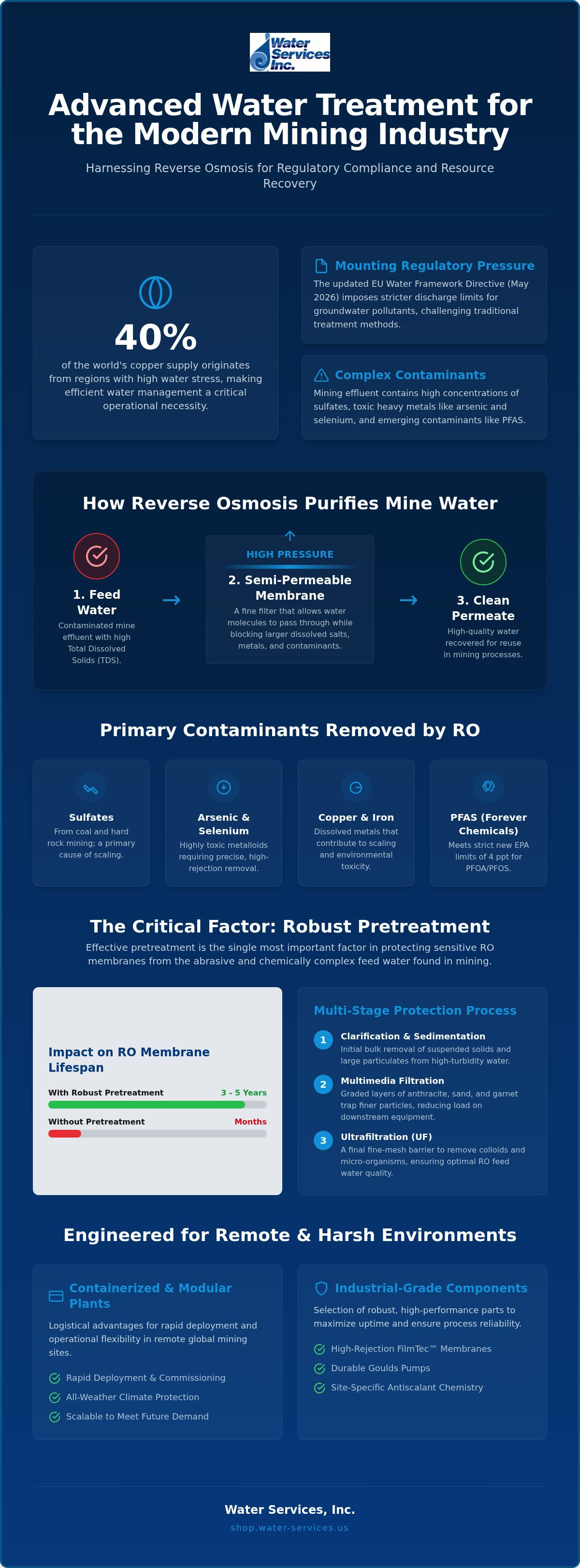
Approximately 40% of the world's copper supply originates from regions facing high water stress, making efficient water management a non-negotiable operational requirement. Mining operators face a difficult balance between meeting the EU's updated May 2026 Water Framework Directive and managing high concentrations of sulfates and heavy metals in remote locations. You know that traditional treatment methods often fall short when discharge standards for arsenic and selenium tighten. It's a logistical and technical challenge that requires precision engineering and reliable reverse osmosis for mine water treatment.
This guide explains how advanced RO systems solve complex mining wastewater challenges while ensuring regulatory compliance and resource recovery. We will examine the engineering of containerized RO plants, the selection of high-rejection FilmTec membranes, and the integration of Goulds pumps to minimize downtime and maximize process water reuse. By focusing on modular design and robust pretreatment, your facility can achieve stable operations despite the increasingly strict environmental landscape of 2026.
Key Takeaways
- Understand the technical role of reverse osmosis for mine water treatment in removing dissolved solids and heavy metals to meet updated 2026 environmental discharge standards.
- Identify why robust pretreatment is the most critical factor for extending the lifespan of membranes when processing complex, high-turbidity mining effluent.
- Evaluate the logistical advantages of containerized and modular RO plants for rapid deployment and climate protection in remote global mining operations.
- Compare high-performance thin-film composite membranes from FilmTec and Hydranautics to optimize salt rejection and flux in high-TDS applications.
- Learn how site-specific engineering and the selection of industrial-grade components, such as Goulds pumps, maximize resource recovery and minimize operational downtime.
The Role of Reverse Osmosis in Modern Mine Water Management
Reverse osmosis for mine water treatment functions as a high-pressure separation process. It utilizes semi-permeable membranes to isolate dissolved solids and heavy metals from complex mining effluent. As of May 2026, the updated EU Water Framework Directive has introduced stricter limits on groundwater pollutants, specifically targeting sulfate, arsenic, and selenium. Conventional treatment methods, such as lime precipitation, often fail to meet these revised standards because they can't achieve the necessary reduction in total dissolved solids (TDS).
Modern mining operations are moving toward Zero Liquid Discharge (ZLD) models. This shift prioritizes resource recovery over simple disposal. Advanced RO systems effectively address primary contaminants that threaten local ecosystems and regulatory standing. These include:
- Sulfates: High concentrations common in coal and hard rock mining.
- Arsenic and Selenium: Toxic metalloids requiring precise rejection rates.
- Copper and Iron: Dissolved metals that cause scaling and environmental toxicity.
- PFAS: Emerging contaminants now subject to strict EPA Maximum Contaminant Levels.
Industrial operators rely on components like FilmTec membranes to ensure high rejection rates. Engineering these systems requires a focus on durability to handle the abrasive nature of mine water.
Treating Acid Mine Drainage (AMD)
Acid Mine Drainage occurs when sulfide minerals are exposed to air and water, resulting in sulfuric acid production. This acidic water leaches heavy metals from surrounding rock, creating a highly corrosive effluent. RO systems integrate with neutralization and precipitation stages to provide a final polishing step. The process reduces overall acidity while capturing dissolved metal ions that traditional chemical treatments leave behind. It ensures the final discharge meets the rigorous 4 ppt PFOA/PFOS standards and heavy metal limits now influencing industrial permits in 2026.
Process Water Recovery and Reuse
Water management is a critical operational risk. Roughly 40% of global copper supply comes from water-stressed regions. Reverse osmosis for mine water treatment allows operators to recover high-quality permeate for reuse in heap leaching and flotation circuits. This closed-loop approach reduces the facility's water footprint and provides significant economic benefits in arid environments. By reusing process water, mines decrease their reliance on local freshwater sources and minimize the logistical costs of water transport. It's a strategy that stabilizes production schedules by securing a reliable water supply regardless of local drought conditions.
Overcoming Feed Water Challenges: Pretreatment for Mining RO
Mine water is frequently categorized as the ultimate challenge for membrane longevity. High turbidity and fluctuating concentrations of suspended solids lead to rapid mechanical fouling if not managed correctly. Effective reverse osmosis for mine water treatment requires a robust pretreatment sequence to protect sensitive membrane surfaces from the abrasive and chemically complex feed water typical of mining environments. Without these barriers, industrial membranes can fail within months, far short of their expected three to five year operational lifespan.
Scaling potential represents the calculated risk that dissolved salts, particularly sulfates and silica, will precipitate and form solid deposits on the membrane as the water becomes increasingly concentrated during the process.
High turbidity in mine water often originates from tailings pond runoff or underground seepage. This particulate matter can lodge in the feed spacers of RO membranes, causing immediate pressure drops and reduced flux. Effective management involves using clarifiers or high-rate sedimentation tanks before the secondary filtration stages. This sequential approach reduces the load on the primary equipment and extends the intervals between Clean-In-Place (CIP) cycles. Reliability in these initial stages is paramount for remote sites where logistical delays for replacement parts are common.
Filtration and Clarification Stages
Bulk removal of suspended solids begins with multimedia filter tanks. These units use graded layers of anthracite, sand, and garnet to trap large particulates. Following this, mobile ultrafiltration (UF) systems provide a fine-mesh barrier against colloids and micro-organisms. This physical separation is essential for maintaining a low Silt Density Index (SDI) before the water enters the RO stage. Pentair filter housings and Harmsco filtration products are often integrated at this stage to provide final polishing and protect high-pressure pumps from abrasive wear. For a technical deep dive, review our guide on Industrial Water Filtration Systems.
Chemical Preconditioning
Chemical preconditioning addresses the dissolved minerals that physical filters cannot catch. High-performance antiscalants are injected using Pulsafeeder metering pumps to keep calcium sulfate and silica in solution. Polyamide membranes also require strict dechlorination. Residual chlorine from upstream disinfection will oxidize and destroy the thin-film composite structure of membranes like the FilmTec SW30 series. Automated Walchem controllers manage these dosing levels based on real-time sensor data from Signet flow sensors and Ashcroft pressure gauges. Selecting the right water treatment chemicals is a critical engineering step to prevent unplanned downtime. Proper dosing ensures the RO system operates within its design flux and maintains high rejection rates for heavy metals like arsenic and selenium.
Deploying Modular and Containerized RO Systems in Remote Sites
Containerized systems represent the current standard for reverse osmosis for mine water treatment in remote areas. These units eliminate the need for extensive on-site civil engineering. Traditional plant construction often requires months of concrete work and infrastructure development. Modular RO plants arrive in standard ISO shipping containers; they are pre-piped and pre-wired for immediate integration. This plug-and-play design is essential for sites in Africa, South America, and the Middle East where local construction resources are limited. By centralizing the engineering in a controlled facility, operators avoid the delays and quality control issues common with field-built projects.
Scalability is a primary advantage. As mine production increases, operators can deploy additional containerized units to match the rising effluent volume. This incremental approach allows for better capital management. The global market for mining water treatment systems is estimated to be USD 5.3 billion in 2026. This growth is driven by the flexibility of modular systems. The estimated capital expenditure for a reverse osmosis plant in 2026 ranges from $400 to $800 per cubic meter of daily capacity. Modular systems keep these costs predictable and manageable while reducing the total project timeline from years to months.
Mobile Treatment Plant Rental vs. Purchase
The decision between rental and purchase depends on project duration and available capital. Rental options provide flexibility for short-term dewatering or emergency response scenarios. While the operational expenditure (OPEX) for mining RO typically falls between $0.15 and $0.40 per cubic meter, long-term ownership usually offers the lowest total cost of ownership. Operators must consider the three to five year lifespan of membranes when calculating these costs. For detailed engineering comparisons, see our article on Mining Wastewater Treatment Solutions.
Ruggedized Engineering for Harsh Environments
Remote mining sites subject equipment to extreme heat, dust, and corrosive air. Containerized units include integrated HVAC systems to maintain stable temperatures for sensitive electronics and membranes. High-pressure reliability is maintained through Goulds Water Technology Pumps, specifically duty-rated models like the 3181 series. Internal piping uses 316L stainless steel or specialized coatings to resist the corrosive nature of acid mine drainage. This ruggedized construction ensures the system remains operational in environments that would degrade standard industrial equipment. Using industrial-grade components like Ashcroft pressure gauges ensures accurate monitoring in these demanding conditions.
Selecting Membranes and Antiscalants for High-TDS Mine Effluent
Polyamide thin-film composite (TFC) membranes are the primary technology for reverse osmosis for mine water treatment. These membranes consist of a thin active layer supported by a porous polysulfone layer. Engineering teams must balance permeate flux with rejection efficiency. High-rejection membranes often require higher operating pressures, which increases energy consumption. Conversely, high-flux membranes may permit higher levels of passage for specific ions like boron or nitrate. Precise selection ensures the system meets the May 2026 EU standards for sulfate and selenium discharge.
Next-generation membranes available in 2026 provide enhanced polymer cross-linking that increases sulfate rejection rates to over 99% even in high-scaling environments.
FilmTec and Hydranautics represent the two leading brands for mining applications. DuPont FilmTec SW30-4040 and BW30HRLE-440 models are frequently specified for their high rejection of salts and heavy metals. Hydranautics membranes are noted for their performance in high-fouling environments. Selecting between these brands depends on specific feed water chemistry and target recovery rates. When systems underperform, membrane autopsies provide essential data. These physical and chemical examinations of sacrificial elements identify the exact nature of fouling, whether it is mineral scaling, organic loading, or biofouling. This diagnostic process allows for the adjustment of pretreatment chemistry to protect the remaining membrane stack.
Membrane Selection Criteria
Mine dewatering projects often encounter varying TDS levels. Brackish water (BW) membranes are suitable for TDS levels up to 10,000 mg/L. Deep mine dewatering, which can reach seawater-level salinity, requires seawater (SW) membranes to handle the higher osmotic pressure. For process water containing residual flotation reagents or organic matter, fouling-resistant (FR) chemistries are necessary. These membranes feature a modified surface charge that reduces the adhesion of organic molecules. You can find replacement elements and specialized components in our Water Treatment Collection.
Optimizing Chemical Dosing
The efficacy of the RO process relies on precise chemical delivery. Pulsafeeder metering pumps ensure exact dosing of antiscalants, which are required to prevent calcium sulfate and silica from precipitating on the membrane surface. Monitoring the differential pressure across membrane stages helps operators determine when the antiscalant threshold is breached. When fouling occurs, Cleaning-in-Place (CIP) protocols must be initiated using specialized acidic and alkaline cleaners. Regular CIP cycles, performed every three to six months depending on pretreatment quality, are vital for maintaining the design lifespan of the equipment. To maintain system integrity, procure high-performance antiscalants and replacement membranes from a verified industrial distributor.
Engineering Compliance and Recovery with Water Services, Inc.
Designing an effective system for reverse osmosis for mine water treatment requires more than standard hardware. Each mining site presents a unique chemical profile, from high sulfate concentrations in coal regions to heavy metal loads in copper operations. Water Services, Inc. provides custom engineering to address these site-specific variables. We ensure that every containerized plant is configured to meet the precise discharge limits of your jurisdiction, including the 2026 EU Water Framework Directive updates. By integrating advanced Electric Power Controls, we automate system management to maintain optimal flux and rejection rates without constant manual intervention. These automated systems utilize Walchem controllers and Signet flow sensors to provide real-time data, ensuring the plant operates within its engineered design parameters.
Our logistical competence extends from our domestic headquarters to international mining hubs. We support operations across the United States, including major sites in Utah, and maintain a robust distribution network for projects in Africa and the Middle East. This global reach ensures that specialized components and technical support are available even in the most remote locations. We manage the entire project lifecycle, from initial design and hardware selection to commissioning and long-term maintenance. This comprehensive oversight minimizes the risk of operational failure in demanding industrial environments where downtime leads to significant production losses.
The Water Services Advantage
Founded in 1994, Water Services, Inc. brings over 32 years of experience to the industrial water treatment sector. We specialize in the design and deployment of modular, containerized RO plants that withstand the rigors of mining. Our status as a distributor for top-tier brands allows us to curate high-performance systems using reliable hardware. We utilize Goulds Water Technology Pumps for high-pressure feed applications and Viqua UV systems for biological control in process water. Additionally, we integrate Harmsco and Pentair filtration products for robust pretreatment, alongside high-rejection FilmTec and Hydranautics membranes. This curated approach positions us as a stable partner for professional users who require exact solutions.
Getting Started with Your Mine Water Project
Successful water management begins with accurate data. We require a detailed feed water analysis to determine the scaling potential and fouling risks of your specific effluent. Our engineering team consults on both direct purchase and rental options to align with your 2026 capital requirements. Whether you need a permanent installation or a mobile unit for short-term dewatering, we provide the technical integrity required for regulatory compliance. Contact our engineering team for a custom mining RO quote to secure your water supply and meet environmental obligations.
Securing Your Mining Water Supply for 2026 and Beyond
Successful water management in the mining sector requires a precise balance between rigorous pretreatment and advanced membrane technology. As environmental regulations tighten globally, implementing robust reverse osmosis for mine water treatment is the only way to ensure stable discharge compliance and high rates of process water reuse. Modular, containerized plants provide the necessary flexibility for remote operations, allowing for rapid deployment and scalability as production demands increase.
Water Services, Inc. has been providing engineering expertise since 1994. We offer global logistics and installation support to keep your facility operational in the most demanding environments. As an authorized distributor for Goulds and FilmTec, we ensure your system utilizes high-performance components designed for industrial durability. You can rely on our technical integrity to solve complex wastewater challenges and optimize your resource recovery.
Shop Industrial RO Components and Containerized Systems to begin optimizing your site's water chemistry today. Our team is ready to help you achieve long-term operational stability.
Frequently Asked Questions
What is the typical recovery rate for reverse osmosis in mining?
Typical recovery rates for reverse osmosis for mine water treatment range from 65% to 85%. The specific rate depends on the concentration of total dissolved solids (TDS) and the presence of scaling ions like calcium and sulfate. High osmotic pressure in deep mine dewatering often limits recovery to the lower end of this range. Engineering teams utilize modeling software to determine the optimal balance between permeate recovery and membrane longevity.
How does reverse osmosis handle Acid Mine Drainage (AMD)?
Reverse osmosis handles Acid Mine Drainage (AMD) by functioning as a final polishing stage following primary neutralization and precipitation. While lime treatment removes the bulk of heavy metals, RO captures residual dissolved ions and reduces sulfate levels to meet 2026 discharge standards. This process ensures the effluent is safe for environmental release or suitable for reuse within the mining circuit, effectively managing the corrosive and acidic nature of AMD.
What are the pretreatment requirements for RO in a mining environment?
Pretreatment for mining RO requires a multi-stage approach including multimedia filtration, ultrafiltration, and precise chemical dosing. Mine water often contains high levels of suspended solids and colloids that cause rapid membrane fouling. By using multimedia filter tanks and mobile ultrafiltration units, operators remove these particulates before the water reaches the RO membranes. This sequence is essential for maintaining a low Silt Density Index (SDI) and protecting high-pressure pumps from abrasive wear.
Can RO systems be used for Zero Liquid Discharge (ZLD) in mines?
RO systems function as the primary volume reduction stage in Zero Liquid Discharge (ZLD) configurations. By concentrating the mine effluent, RO reduces the load on downstream thermal evaporators and crystallizers, which are significantly more energy-intensive. This integration allows mines to achieve total liquid waste elimination while recovering high-quality permeate for process reuse. It is a critical strategy for sites operating in water-stressed regions with strict non-discharge mandates.
How long do RO membranes last in mine water treatment?
Industrial RO membranes in a mining environment typically last between three and five years. This lifespan is heavily dependent on the effectiveness of the pretreatment process and the frequency of Cleaning-In-Place (CIP) cycles. Excessive scaling from sulfates or mechanical damage from abrasive particulates will shorten this duration. Regular monitoring with Walchem controllers and Ashcroft pressure gauges helps operators identify fouling early, allowing for corrective actions that preserve the thin-film composite membrane integrity.
Are containerized RO systems suitable for remote, high-altitude mines?
Containerized RO systems are specifically designed for the rigors of remote, high-altitude mining environments. These units feature integrated HVAC systems and insulated walls to maintain stable operating temperatures for membranes and electronics. The modular nature of these plants allows for rapid transport and installation in locations where traditional construction is logistically impossible. They provide a controlled environment that protects sensitive equipment from extreme weather, dust, and pressure fluctuations common at high elevations.
What is the difference between renting and buying a mobile water treatment plant?
Renting a mobile water treatment plant is ideal for short-term dewatering or emergency response, while purchasing offers the best total cost of ownership for long-term projects. Rental agreements allow operators to manage costs through operational expenditure (OPEX) without a large initial capital outlay. Ownership requires a higher capital expenditure (CAPEX) but provides full control over the asset and lower long-term costs. Both options provide access to industrial-grade components like Goulds pumps and FilmTec membranes.
How do antiscalants prevent membrane fouling in high-sulfate water?
Antiscalants prevent membrane fouling by interfering with the crystal growth of minerals like calcium sulfate and silica. In high-sulfate mine water, these chemicals delay precipitation, allowing the concentrated salts to stay in solution and pass through the system into the reject stream. Precision dosing with Pulsafeeder metering pumps is required to maintain the correct concentration. This chemical management is vital for reverse osmosis for mine water treatment to prevent irreversible scaling that would otherwise block the membrane pores.
0 comments