

What if the reliability of your entire industrial water treatment plant depends on a single $15 port connector rather than the high-pressure pump? Most operators focus on membrane rejection rates, yet a significant portion of unplanned system downtime stems from minor leaks at connection points. Selecting the right RO membrane housing fittings for industrial water systems is critical to maintaining a zero-leak environment under typical 50 to 100 PSI loads. It's frustrating to manage material degradation from harsh chemicals or struggle with the compatibility between MNPT and socket connection standards when your production schedule is on the line.
You'll master the technical specifications and selection criteria for industrial RO housing fittings to ensure leak-free, high-pressure performance. This 2026 guide covers the current NSF/ANSI/CAN 61-2025 standards and the impact of NSF/ANSI/CAN 600 on material selection. We'll also address how to future-proof your infrastructure against the 2026 EPA requirements for PFAS data collection in NPDES permit applications. By the end of this guide, you'll be able to standardize your parts for simplified maintenance and long-term corrosion resistance.
Key Takeaways
- Understand why industrial pressure vessel connections require higher safety factors than standard commercial components to maintain high-PSI integrity.
- Differentiate between PVC and CPVC materials to ensure fittings withstand aggressive Clean-In-Place (CIP) cycles without structural degradation.
- Master the selection of RO membrane housing fittings for industrial water systems, focusing on TBE galvanized steel nipples for non-potable air-assisted lines.
- Reduce system downtime by integrating Y-strainers for particulate protection and using dedicated wrenches to prevent port cracking during maintenance.
- Leverage global shipping and Utah-based technical expertise to source high-quality, standardized components for custom modular water treatment plants.
Understanding RO Membrane Housing Fittings in Industrial Contexts
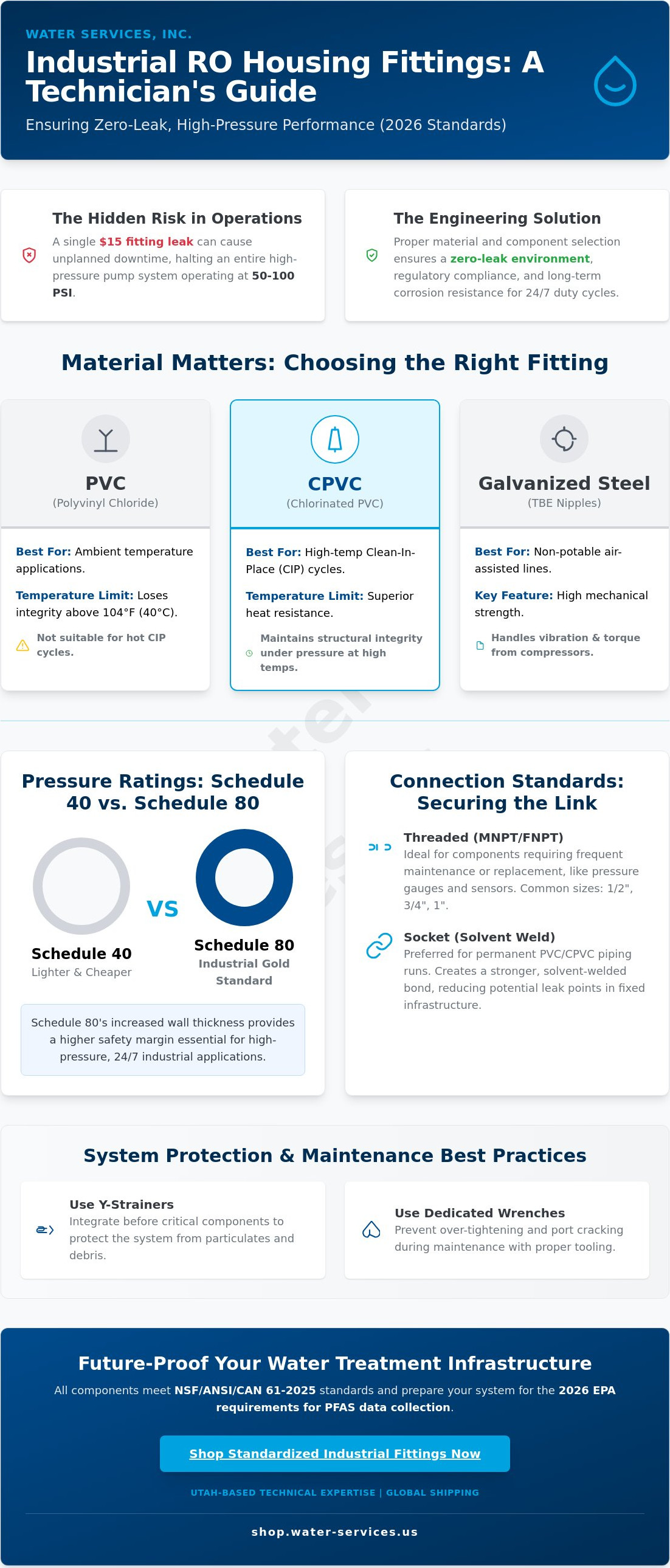
Industrial RO membrane housing fittings are the specialized hardware components that bridge the gap between high-pressure vessels and the larger process piping network. In heavy-duty Reverse osmosis (RO) plants, these fittings serve as the critical interface for permeate collection, concentrate discharge, and high-pressure feed entry. Unlike residential systems that utilize plastic push-to-connect parts, industrial configurations require components capable of sustaining 50 to 100 PSI for extended 24/7 duty cycles. These systems demand higher safety factors, often rated for burst pressures four to six times higher than the operating load, to account for hydraulic shocks and thermal expansion in mining or military environments.
As of 2026, the technical requirements for RO membrane housing fittings for industrial water systems have become more stringent. New EPA rules regarding PFAS data collection in NPDES permit applications mean that any system leak is a potential regulatory liability. Precision-engineered fittings ensure that high-solids feed water stays contained while purified permeate is moved to storage without contamination. These components must also comply with NSF/ANSI/CAN 61-2025 standards to ensure no chemical impurities are imparted to the treated water stream, maintaining a TDS rejection rate of 95-98% across the membrane surface.
The Role of Pressure Vessels in RO Systems
Pressure vessels act as the structural backbone of a filtration skid. They protect the internal RO membranes so they don't sustain damage from physical impact or the immense internal forces generated by high-pressure pumps. In 2026, fiberglass reinforced plastic (FRP) is the preferred housing material for its high strength-to-weight ratio and immunity to salt-water corrosion. While PVC and CPVC housings exist for light industrial use, heavy-duty applications rely on FRP or 316L stainless steel. Proper housing selection is the first step in building reliable Industrial Water Treatment Systems that can withstand the rigors of industrial cleaning cycles.
Connection Standards: MNPT, FNPT, and Socket
Understanding the differences between National Pipe Thread (NPT) standards is essential for leak-free operation. Most industrial ports utilize 1/2 inch, 3/4 inch, or 1 inch MNPT (Male) and FNPT (Female) connections to interface with instrumentation like Ashcroft pressure gauges. Socket connections are typically preferred in containerized RO plants for permanent PVC or CPVC piping runs because they offer a stronger, solvent-welded bond. Threaded connections remain the standard for parts that require frequent maintenance or replacement. Selecting the correct standard prevents port stress, so the system doesn't fail under pressure during 24/7 operation.
Material Selection: PVC, CPVC, and Galvanized Steel Fittings
Selecting the correct material for RO membrane housing fittings for industrial water systems is a technical decision based on chemical compatibility and thermal limits. Standard PVC (Schedule 40 or 80) works for most ambient temperature applications. However, industrial systems often require Clean-In-Place (CIP) cycles where temperatures can exceed 104°F (40°C). In these scenarios, CPVC is the superior choice. It maintains structural integrity at higher temperatures where standard PVC might soften and fail under pressure. This is especially relevant when following strict FDA guidelines on Reverse Osmosis purity levels in food or pharmaceutical processing.
For non-potable applications such as air-assisted backwash or gas-injection lines, galvanized steel nipples are often preferred. Their mechanical strength handles the vibration and torque of air compressors better than plastic alternatives. In mining wastewater treatment, material selection is even more critical. Corroded metal fittings can leach iron or zinc into the permeate stream, compromising the entire process. Using a CPVC Reducer Bushing, 1/2" x 1/4" ensures a chemically resistant transition for precision dosing or sensor ports without the risk of metallic contamination.
Schedule 40 vs. Schedule 80: Pressure Ratings
Schedule 80 is the industrial gold standard due to its increased wall thickness. While Schedule 40 is lighter and cheaper, it doesn't offer the same safety margins for high-pressure industrial RO. For example, a 12 inch Class 125 PVC Cap provides the necessary pressure rating for large-scale vessel ends that must withstand 125 PSI. Outdoor installations in Africa or the Middle East face extreme temperature swings. Thicker Schedule 80 walls resist thermal shock and UV degradation better than Schedule 40, preventing cracks during 2026 summer peak heat.
Chemical Compatibility and RO Cleaning
Antiscalants and acidic cleaners are necessary for membrane longevity but they're aggressive on fittings. Seal selection is just as vital as the fitting material itself. EPDM is standard for many water applications, but Viton is required when the system uses specific petroleum-based additives or highly concentrated acids. It's essential to match the seal to the chemical cleaning protocol to prevent O-ring swelling and subsequent leaks. You can find a wide variety of these specialized industrial pipe fittings to match your specific chemical requirements.
Key Components for RO System Integration and Sizing
Integrating RO membrane housing fittings for industrial water systems requires a precise understanding of component sizing and mechanical loads. While the housing holds the membrane, the fittings dictate the hydraulic efficiency of the entire skid. Pipe nipples, specifically Threaded Both Ends (TBE) galvanized steel variants, provide the necessary rigidity for air and gas-assisted backwash lines. These components must withstand vibration from high-pressure pumps and the cyclical stress of automated valves. This level of mechanical durability is a core requirement highlighted in the FDA guide to reverse osmosis, which emphasizes system integrity to prevent external contamination.
Reducer bushings are essential for adapting large housing ports to smaller instrumentation or dosing lines. They allow for the seamless integration of chemical injection points without requiring custom-drilled housings. For large diameter piping systems, Class 125 PVC caps secure header pipes and distribution manifolds. It's a matter of balancing maintenance speed with structural security. Quick-connect fittings facilitate rapid component replacement during a 48 hour maintenance window, but permanent solvent-welded or threaded connections offer superior long-term reliability in high-vibration environments. Choosing the right RO membrane housing fittings for industrial water systems ensures that your system doesn't suffer from avoidable pressure drops or joint failures.
Adapting Ports for Instrumentation
Precise monitoring ensures an RO system operates within its design parameters. Integrating Ashcroft pressure gauges into housing ports often requires a transition from a 1 inch port to a 1/4 inch gauge stem. Using a high-quality reducer bushing prevents leaks at these critical data points. For remote sites, selecting MNPT x TBE nipples ensures that the instrumentation remains secure even during transport or heavy seismic activity. These physical connections are the foundation for advanced Electric Power Controls that monitor permeate quality and flow rates in real-time.
Large Diameter Piping Solutions
Managing high-flow concentrate lines is a primary concern in mining wastewater treatment. These systems frequently utilize 12 inch Class 125 PVC cap sockets to manage the high volume of reject water. Large-scale modular header systems rely on these caps to maintain pressure across multiple membrane banks. Success depends on proper solvent welding techniques. Technicians must ensure a uniform application of primer and cement to prevent joint failure under the 100 PSI loads typical of heavy industrial filtration. This attention to detail ensures the system meets the 95-98% TDS rejection rates required for environmental compliance.
Maintenance, Pre-filtration, and Tooling for RO Fittings
Proper maintenance protocols extend the service life of RO membrane housing fittings for industrial water systems by preventing mechanical stress and chemical fouling. Large particulates are the primary enemy of high-pressure seals and port threads. Integrating a Y-strainer into the feed line captures debris before it can lodge in the housing ports. Technicians must also monitor for mineral scale buildup. If left unchecked, calcium and magnesium deposits create flow restrictions that increase backpressure and strain every connection point in the system. This buildup often occurs on the concentrate side where mineral concentrations are highest. Regular inspection of the reducer bushings and nipples prevents these restrictions from causing a system-wide pressure spike.
Essential Tools for RO Technicians
Site operators require specialized equipment to perform membrane swaps without damaging expensive hardware. A Housing Wrench, 12.25" H is a non-negotiable tool for this process. Unlike generic wrenches, this tool provides even torque distribution. This prevents the port cracking often caused by uneven manual pressure. Overtightening is a leading cause of failure in industrial settings. During maintenance, technicians should inspect O-rings for flat spots or brittle texture. Use only approved lubricants to ensure a leak-free seal. Always wear the correct Personal Protective Equipment (PPE) when handling antiscalants or acidic cleaning agents. Safety protocols are vital when working around high-pressure vessels and corrosive chemicals.
Pre-filtration Fittings and Accessories
Protecting the RO skid begins with effective pre-filtration. Integrating a Y-Strainer, 1-1/2" Polypropylene provides a rugged first line of defense against coarse solids. For finer sediment control, operators must choose between string-wound and melt-blown cartridges. String-wound filters offer high dirt-holding capacity for variable water quality. Melt-blown versions provide more precise micron ratings for consistent feed water. Managing flow rates between 10 gpm and 50 gpm requires specialized filter bags designed for high-volume throughput. These filter bags prevent silt and sand from reaching the RO membrane housing fittings for industrial water systems. Without this protection, abrasive particles can score the internal surfaces of the fittings, leading to bypass leaks that compromise permeate quality.
Ensure your system remains leak-free by sourcing the correct industrial pipe fittings for your specific operating environment.
Procuring Industrial Fittings from Water Services, Inc.
Procuring RO membrane housing fittings for industrial water systems requires more than a simple transaction; it's about ensuring the technical integrity of a high-pressure filtration skid. Water Services, Inc. operates as a specialized industrial distributor rather than a generic e-commerce site. We maintain a robust inventory of 2000+ pipe fitting SKUs at our Provo, Utah headquarters. This logistical base allows for immediate deployment to remote sites in Africa, South America, and the Middle East. Our team understands the urgency of mining and military operations where unplanned downtime results in significant production loss. We prioritize logistical competence to ensure your parts arrive exactly when they're needed.
Engineering support is the core of our procurement process. We sell the same high-quality components we use in our own containerized reverse osmosis plants. This firsthand experience ensures that the RO membrane housing fittings for industrial water systems you order are compatible with high-performance hardware like Goulds Water Technology pumps. A high-pressure pump's discharge must align perfectly with the RO housing manifold to prevent hydraulic turbulence and vibration-induced leaks. Buying from a specialized distributor means you receive parts that have been vetted for industrial durability and chemical resistance.
The Water Services, Inc. Advantage
Our approach is engineering-led, focusing on the functional value of the equipment. We don't just provide parts; we offer ruggedized water solutions for the most demanding environments. Whether you're managing a mobile ultrafiltration system or a permanent desalination plant, our team verifies that your fittings meet the necessary PSI and chemical resistance ratings. We provide a level of technical focus that generic retailers cannot match.
- Military-grade reliability for remote and harsh deployments.
- Immediate global shipping on 2000+ specialized pipe fitting SKUs.
- Provo-based technical support for custom modular water treatment systems.
- Proven inventory of heavy-duty components tested in real-world industrial skids.
Final Checklist for Your RO Fitting Order
Before finalizing your procurement, run through this technical checklist. It prevents the common error of receiving incompatible parts at a remote job site where returns are difficult. Verify that your order includes the specific measurements and materials discussed in this guide. Ensuring you have the right tools on hand is just as important as the fittings themselves.
- Verify PSI ratings: Ensure every fitting matches the 50 to 100 PSI operating range of your membranes.
- Confirm thread types: Match MNPT/FNPT or socket standards to your existing pressure vessels.
- Material compatibility: Select CPVC for high-temperature CIP cycles or galvanized steel for non-potable air lines.
- Maintenance kit: Include spare O-rings and a 12.25" H housing wrench for safe installation.
Ready to secure your system with quality water equipment you can trust? Browse our full collection of 2000+ Industrial Pipe Fittings to find the exact specifications for your project.
Optimize Your 2026 Industrial Water Infrastructure
Maintaining a zero-leak plant requires a focus on technical precision. You've learned that selecting CPVC over standard PVC is essential for high-temperature Clean-In-Place cycles. Using the correct 12.25 inch housing wrench prevents the port stress that leads to costly system downtime. These details ensure your RO membrane housing fittings for industrial water systems remain compliant with the latest NSF/ANSI/CAN 61-2025 standards. It's a strategy that prioritizes total cost of ownership over cheap, generic alternatives.
Water Services, Inc. has provided quality water equipment since 1994. From our headquarters in Provo, Utah, we offer specialized technical support for Goulds, FilmTec, and Pentair components. Our global project experience ensures your equipment arrives ready for immediate deployment in mining or military environments. We prioritize the technical integrity of every part we ship to ensure your operational success. Don't leave your system's reliability to chance.
Shop the Industrial Pipe Fittings Collection to access our inventory of 2000+ specialized SKUs. We look forward to supporting your next modular water treatment project with the reliability your industry demands.
Frequently Asked Questions
What is the difference between Schedule 40 and Schedule 80 fittings for RO systems?
Schedule 80 fittings feature thicker walls and higher pressure ratings than Schedule 40 variants. This makes Schedule 80 the industrial standard for the high-pressure feed and concentrate lines of an osmosis skid. Schedule 40 is typically reserved for low-pressure permeate storage or gravity-fed drain lines where mechanical stress is minimal.
Can I use galvanized steel fittings for potable RO permeate water?
No, galvanized steel is not suitable for potable RO permeate because the aggressive, low-TDS water rapidly corrodes the zinc coating. This corrosion leads to metal leaching and compromises water purity. For potable permeate applications, use 316L stainless steel or NSF/ANSI/CAN 61-2025 certified plastics to ensure compliance with health standards.
How do I know if I need a CPVC reducer bushing instead of standard PVC?
Use a CPVC reducer bushing if your process water temperature exceeds 104°F (40°C) or if your Clean-In-Place (CIP) cycles involve aggressive chemicals. CPVC maintains its structural integrity and pressure rating at higher temperatures where standard PVC softens. For ambient water filtration below 104°F, standard PVC is often sufficient for most RO membrane housing fittings for industrial water systems.
What are the most common leak points in an industrial RO membrane housing?
The most frequent leak points are the threaded interface between the housing port and the fitting, and the end-cap O-ring seals. Overtightening a male fitting into a female port often causes hairline fractures in the housing material. Additionally, O-rings that aren't lubricated during installation can twist or tear, leading to bypass leaks that compromise the 95-98% TDS rejection rate.
How often should I replace the O-rings in my RO housing fittings?
Replace all O-rings during every membrane swap or at least every 12 to 24 months of continuous operation. Seals experience compression set and chemical degradation over time, which reduces their elasticity. Regular replacement is a low-cost preventive measure that ensures zero-leak operation at high PSI and prevents unplanned system downtime.
What is the maximum pressure rating for a 12" PVC Cap Socket?
A 12 inch Class 125 PVC Cap Socket is rated for a maximum pressure of 125 PSI at a base temperature of 73°F (23°C). It's critical to note that this pressure rating decreases as the operating temperature rises. Always consult the specific pressure-temperature derating charts for your RO membrane housing fittings for industrial water systems to ensure safe operation.
Do you provide international shipping for large industrial fitting orders?
Yes, Water Services, Inc. ships high-quality fittings and equipment worldwide from our Provo, Utah headquarters. We regularly manage complex logistics for mining and military projects in Africa, South America, and the Middle East. We maintain an inventory of 2000+ specialized SKUs to ensure immediate deployment for global water treatment requirements.
Which wrench should I use for Pentair filter housings?
Use a dedicated 12.25" H housing wrench specifically designed for large-diameter filter housings. This tool allows for the even distribution of torque around the housing circumference, which prevents the point-loading stress caused by standard pipe wrenches. Using the correct wrench is the most effective way to prevent port cracking and extend the life of your filtration hardware.
0 comments