

The most expensive motor in your facility isn't the one with the highest purchase price. It's the unit that triggers an unscheduled plant shutdown because of moisture ingress or chemical corrosion. You've likely dealt with the frustration of a replacement motor that doesn't fit your existing Goulds pump frame or an older design that inflates utility costs. Specifying definite purpose motors for water treatment pumps requires a shift in focus from simple horsepower to environmental matching. This ensures the enclosure and internal components can survive the rigors of mining and industrial wastewater processing.
We agree that maintaining system uptime is your primary objective. This guide provides the technical specifications needed to procure high-reliability motors that withstand harsh conditions while meeting 2026 energy efficiency benchmarks. You'll learn how to ensure seamless mechanical integration and prepare for upcoming DOE mandates to keep your operations both compliant and profitable. We will examine enclosure ratings, frame compatibility for major pump brands, and the impact of the latest IE5 efficiency standards on your total cost of ownership.
Key Takeaways
- Distinguish between general-purpose hardware and specialized designs to ensure motor longevity in corrosive or high-moisture environments.
- Identify specific NEMA frame sizes, such as 145TC, to guarantee seamless mechanical integration with Goulds pump hardware and other industrial frames.
- Learn how to specify definite purpose motors for water treatment pumps based on application-specific needs like VFD compatibility for reverse osmosis systems.
- Utilize a technical procurement checklist to verify critical nameplate data, including voltage, phase, and thermal requirements, before finalizing equipment orders.
- Optimize total system reliability by matching V-belt specifications and high-pressure hose ratings to motor torque and discharge requirements.
Understanding Definite Purpose Motors in Water Treatment Infrastructure
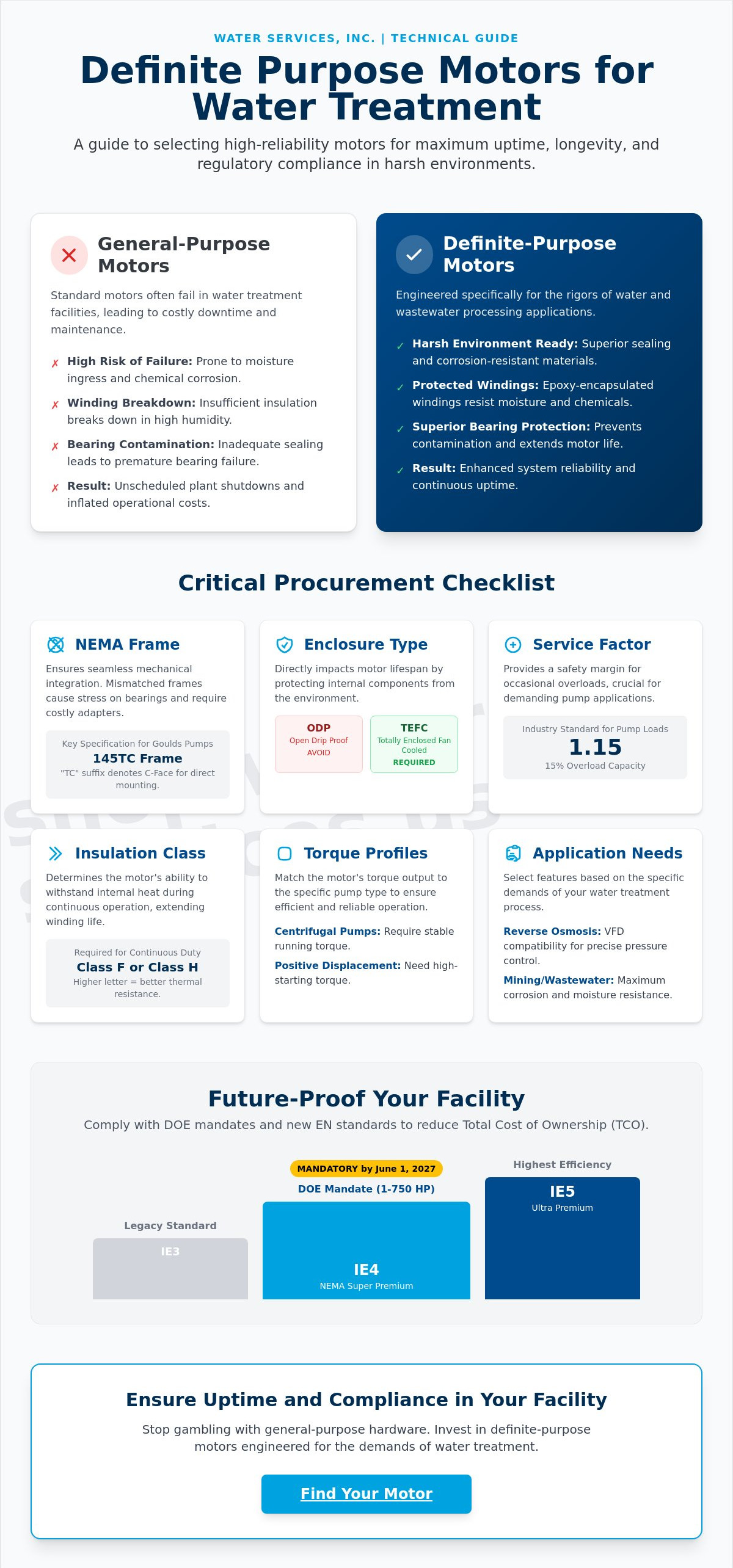
Definite purpose motors differ from general-purpose machinery through their specialized mechanical construction. While standard AC motors provide reliable rotation for basic industrial fans or conveyors, they often lack the sealing and torque characteristics required for fluid handling. Specifying definite purpose motors for water treatment pumps ensures that the hardware can manage high-starting torque and continuous duty cycles without premature winding failure. These units feature specialized enclosures designed to protect against the chemical vapors and high humidity levels found in municipal and industrial treatment plants.
Maintaining a constant flux in commercial reverse osmosis water filtration systems requires precise motor performance. If the motor speed fluctuates or the torque drops, the pressure across the membrane surface becomes inconsistent. This leads to membrane fouling and reduced permeate quality. For high-pressure applications using Goulds Water Technology Pumps, the motor must provide stable power delivery under varying load conditions to protect the integrity of the RO process.
Procurement strategies in 2026 must account for evolving efficiency mandates. The U.S. Department of Energy (DOE) has confirmed that by June 1, 2027, mid-range motors from 1 to 750 horsepower must meet IE4 (NEMA Super Premium) efficiency levels. Additionally, the EN IEC 60034-30-1:2026 standard introduced in January 2026 now recognizes the IE5 class, representing the highest efficiency level currently available. Selecting definite purpose motors for water treatment pumps that only meet older IE2 or IE3 standards may result in a non-compliant system before the equipment reaches its mid-life service interval.
The Cost of "General Purpose" Failures
Standard motors often fail in water treatment due to winding insulation breakdown caused by moisture ingress or bearing contamination. In remote mining operations, a single motor failure can halt production for days. The logistical cost of transporting a replacement to a remote site often exceeds the price of the motor itself. Utilizing motors with superior bearing protection and epoxy-encapsulated windings ensures the system resists corrosion and maintains uptime in 100% humidity environments.
Key Performance Metrics for Pump Motors
Reliable pump operation depends on specific technical metrics that general-purpose motors rarely prioritize:
- Service Factor (SF): A rating of 1.15 is the industry standard for pump loads, providing a 15% safety margin for occasional overloads.
- Insulation Class: Class F or Class H insulation is required for continuous duty to manage internal heat and extend the life of the motor.
- Torque Profiles: Centrifugal pumps require stable running torque, while positive displacement pumps need high-starting torque to overcome initial system pressure.
Technical Specifications: NEMA Frames, Enclosures, and IP Ratings
Selecting the correct frame size is the first step toward mechanical compatibility. NEMA (National Electrical Manufacturers Association) frame numbers, such as 145TC, provide a standardized language for dimensions like bolt hole patterns and shaft heights. The "TC" suffix indicates a C-Face motor designed for direct mounting to equipment, which is essential when integrating definite purpose motors for water treatment pumps with high-pressure pump heads. Without this specific designation, you risk a mechanical mismatch that requires expensive adapters or shaft couplings. It's critical to match these dimensions exactly to avoid unnecessary stress on the drive end bearings.
Enclosure selection directly impacts the lifespan of the motor in harsh environments. Open Drip Proof (ODP) motors allow air to circulate through the windings but offer minimal protection against moisture. Conversely, Totally Enclosed Fan Cooled (TEFC) motors prevent the free exchange of air between the inside and outside of the case. A TEFC enclosure serves as the industrial baseline for any outdoor water treatment installation to prevent internal contamination. For high-pressure washdown areas, engineers look toward Ingress Protection (IP) ratings. While IP55 is common for standard industrial use, IP69K is required for systems subjected to high-temperature, high-pressure jets. Pumping plant performance depends heavily on these environmental seals to prevent insulation failure and maintain efficiency.
Mechanical Fitment: C-Face and Square Flange Mounts
The "TC" designation is a non-negotiable requirement for direct-coupled Goulds Water Technology Pumps. This flange type ensures the motor shaft aligns perfectly with the pump impeller, reducing vibration and bearing wear. When upgrading legacy systems, you must verify both the shaft diameter and length. Standard NEMA frames usually follow predictable patterns, but older pump hardware may require specific shaft extensions. If you are uncertain about your current configuration, reviewing your motor control and power specifications can help identify the correct replacement.
Environmental Protection Standards
Severe Duty motors are engineered for the most aggressive atmospheres, often featuring epoxy coatings and internal tropicalization to resist chemical vapors. In chemical dosing zones, specify Washdown Duty motors with 300-series stainless steel or white epoxy finishes to prevent corrosion from acidic antiscalants. Navigating international procurement requires converting NEMA specifications to IEC (International Electrotechnical Commission) standards. While NEMA frames are measured in inches, IEC frames use millimeters. For example, a NEMA 145T frame is roughly equivalent to an IEC 90L frame, but mounting hole positions and shaft sizes differ. Always verify the physical footprint before ordering definite purpose motors for water treatment pumps for global sites to avoid installation delays.
Application-Specific Selection: From Reverse Osmosis to Wastewater
Application-specific selection ensures the electrical hardware matches the hydraulic demand. Selecting definite purpose motors for water treatment pumps involves more than just checking the horsepower rating. A motor driving a high-pressure pump in a desalination plant faces different thermal and mechanical stresses than one powering a wastewater lift station. Each environment dictates specific insulation, cooling, and torque profiles to prevent catastrophic failure. It's not enough for the motor to turn; it must turn reliably under the specific load characteristics of the fluid being moved.
Motors for Desalination and RO Systems
Reverse osmosis requires constant pressure to maintain permeate flow. Matching motor speed to pump curves is critical for membrane performance. Most modern RO plants utilize Variable Frequency Drives (VFDs) to optimize energy use. You must select motors with "VFD-Ready" insulation to prevent bearing fluting caused by common-mode voltage. This specialized insulation protects the windings from the voltage spikes inherent in high-frequency switching. For deeper insights into high-purity engineering, review our guide on Industrial Water Treatment Systems.
Wastewater pumps deal with variable loads and suspended solids. These applications require high-starting torque to clear debris and overcome static head. Standard motors often overheat during frequent start-stop cycles. Definite purpose designs for wastewater include enhanced thermal protection to manage these fluctuations without tripping the circuit. If the motor doesn't have the "kick" to start the pump against a full column of water, the system remains stagnant, leading to potential overflows and compliance violations.
Severe Duty for Mining and Remote Sites
Mining sites present unique challenges like abrasive dust and extreme altitudes. Motors operating above 3,300 feet (1,000 meters) require thermal de-rating because the thinner air provides less effective cooling. For deep well extraction, vertical hollow shaft (VHS) motors are the preferred choice. They allow for easy impeller adjustment and provide the necessary support for long shaft strings. These robust units are core components in mining wastewater treatment solutions that require 24/7 reliability in remote geographies.
Precision water treatment chemical dosing relies on small frame motors. These units power metering pumps from brands like Pulsafeeder to deliver exact volumes of antiscalants or disinfectants. Because these motors often operate at low speeds, they must be designed to dissipate heat effectively without the benefit of high-speed fan cooling. Choosing the right definite purpose motors for water treatment pumps in these smaller frame sizes ensures the accuracy of your entire dosing loop and prevents the over-injection of expensive chemicals.
The Industrial Procurement Checklist: Avoiding Costly Selection Errors
Procurement errors in high-pressure water systems lead to immediate operational failure and safety hazards. Use this structured checklist to ensure your replacement hardware meets the specific demands of your facility. When evaluating definite purpose motors for water treatment pumps, you must move beyond simple horsepower ratings and look at the electrical and mechanical interface. Precision at this stage prevents the need for field modifications that void warranties and compromise system integrity.
- Step 1: Verify Nameplate Data. Confirm that the voltage, phase, and frequency match your local grid. A 460V motor will not operate on a 230V circuit without severe damage.
- Step 2: Assess Thermal Requirements. Verify the ambient temperature rating. Motors in enclosed, unventilated pump rooms require higher insulation classes to manage heat.
- Step 3: Determine Protection Level. Match the IP rating and enclosure type to the environment. Use TEFC for general industrial areas and Washdown Duty for chemical dosing skids.
- Step 4: Audit Power Transmission. Inspect the alignment of V-belts, couplings, and high-pressure hoses. Undersizing a motor by even 5% can reduce its lifespan by half.
Total Cost of Ownership (TCO) vs. Purchase Price
The initial purchase price of a motor typically represents only 3% of its total lifetime cost. The remaining 97% is consumed by energy use and maintenance. Upgrading to IE3 or IE4 Premium Efficiency motors provides a documented ROI through reduced kilowatt-hour consumption. It's also vital to consider maintenance accessibility. High-quality electric power controls should be positioned for easy testing and reset without requiring the disassembly of the pump housing or motor shroud.
Common Mistakes in Motor Specification
Ignoring the Service Factor (SF) is a frequent error in variable load applications. While a 1.0 SF motor works for steady loads, a 1.15 SF rating is necessary for pumps that experience intermittent pressure spikes. Another oversight is the lack of shaft grounding rings in systems utilizing Variable Frequency Drives. Without grounding, common-mode voltage causes bearing fluting and rapid mechanical failure. Finally, safety must remain the priority. Technicians should always utilize appropriate personal protective equipment (PPE) when performing high-voltage motor testing or installation to prevent arc flash injuries.
Properly matching your motor to the driven load ensures long-term reliability. Review our full selection of power transmission components to ensure your motor and pump are perfectly coupled for maximum efficiency.
Power Transmission Solutions: Integrating Motors, Belts, and Hoses
Industrial system reliability depends on the synergy between the prime mover and the driven load. When specifying definite purpose motors for water treatment pumps, engineers must also audit the power transmission components that bridge the gap between the motor shaft and the pump impeller. A mismatch in torque capacity or RPM ratings leads to belt slippage, excessive heat, and premature bearing failure. These specialized components ensure the longevity of industrial water filtration systems by maintaining precise speed ratios and absorbing mechanical shocks.
The Power Transmission Collection at shop.water-services.us provides the specific hardware required to complete these industrial drive assemblies. Every component is selected for its ability to withstand chemical exposure and continuous duty cycles typical of mining and municipal water treatment plants. Selecting the right belt or hose is as critical as the motor itself for maintaining system uptime. It's a mistake to overlook the interface where the electrical energy converts to hydraulic work.
Featured Power Transmission Components
- Three-Phase General Purpose Motor, 2 HP (145TC Frame, 575V) - USD 569.60: This unit acts as a versatile workhorse for centrifugal pumps, offering the standardized 145TC frame for direct-coupled compatibility in specialized 575V industrial grids.
- Timing Belts (e.g., 14MGT-1190-125) - USD 1307.99: These high-torque polyurethane belts are designed for precision timing and eliminate the high maintenance requirements of traditional roller chains in clean water environments.
- EPDM Bulk Washdown Hoses (1/2" ID x 50 ft) - USD 95.89: These durable, heat-resistant hoses facilitate treatment plant maintenance by resisting the degrading effects of hot water and common cleaning chemicals.
Optimizing System Synergy
Efficiency is lost when power transmission hardware is treated as an afterthought. Matching Wedge V-Belts, such as the 3V1120 (USD 31.39), to motor pulleys reduces internal friction and improves energy transfer. For pneumatic controls and general utility, Bulk Air and Multipurpose Hoses (USD 211.99) provide the necessary flexibility without sacrificing pressure ratings. Heavy-duty industrial drives often require TRITAN Roller Chain Sprockets (USD 84.08) because of their superior wear resistance in abrasive mining environments. By integrating definite purpose motors for water treatment pumps with these high-performance components, operators minimize downtime and ensure compliance with 2026 operational standards.
Strategic Motor Procurement for 2026 and Beyond
Success in industrial water treatment depends on matching motor enclosures and frame sizes to specific hydraulic loads. As efficiency standards shift toward IE4 and IE5 levels, selecting the correct hardware ensures both regulatory compliance and reduced operational expenses. Proper specification of definite purpose motors for water treatment pumps prevents the unscheduled downtime associated with moisture ingress and mechanical mismatch. These units must be integrated with compatible power transmission components to achieve maximum system synergy and longevity. We've provided specialized technical engineering support since 1994 and serve as an authorized distributor of Goulds Water Technology. Our global logistics network ensures reliable delivery to remote mining and military sites worldwide. You can rely on our experience to maintain your plant's performance under the most demanding environmental conditions. Shop the Full Power Transmission Collection to secure high-reliability components for your facility. Investing in precision-engineered hardware today protects your system's integrity and profitability for years to come.
Frequently Asked Questions
What is the difference between a general purpose and a definite purpose motor?
General purpose motors follow standard NEMA designs for broad industrial applications like fans or conveyors in clean environments. Conversely, definite purpose motors for water treatment pumps feature mechanical modifications for specific service conditions. These include specialized seals to prevent moisture ingress, high-starting torque for positive displacement pumps, and chemical-resistant coatings that protect the housing from corrosive antiscalants.
How do I know if my pump motor needs to be inverter duty?
You must specify an inverter duty motor if your system utilizes a Variable Frequency Drive (VFD) to regulate flow or pressure. Standard motors lack the reinforced insulation required to withstand the voltage spikes produced by VFDs. Inverter duty units include Class F or H insulation and often feature shaft grounding rings to prevent electrical discharge from pitting the internal bearings.
What NEMA frame size is standard for a 2 HP water treatment pump?
The 145TC frame is the industry standard for 2 HP motors in direct-coupled water treatment applications. The "TC" suffix is critical because it identifies a C-Face mounting flange with specific bolt hole patterns and a threaded shaft. This configuration allows the motor to bolt directly to the pump head without the need for separate baseplates or complex couplings.
When should I choose a TEFC motor over an ODP motor for water treatment?
Choose a Totally Enclosed Fan Cooled (TEFC) motor for any environment where moisture, chemical vapors, or dust are present. Open Drip Proof (ODP) motors allow external air to circulate through the windings, making them vulnerable to contamination. TEFC enclosures isolate the internal components from the atmosphere, which is essential for outdoor installations or indoor chemical dosing skids.
Can I use a 575V motor on a 460V system with a VFD?
No, you cannot operate a 575V motor on a 460V power supply even when using a VFD. A standard variable frequency drive cannot boost the output voltage above the incoming line voltage. Attempting this mismatch results in insufficient torque and excessive current draw, which causes the motor to overheat and eventually fail under load.
What IP rating is required for a motor in a mining wastewater environment?
An IP55 rating is the baseline requirement for mining wastewater to protect against dust and low-pressure water jets. If the motor is located in a high-density sludge area or subjected to high-pressure hosing, you should upgrade to IP66. This ensures the enclosure remains dust-tight and protected against heavy seas or powerful water jets common in industrial washdown zones.
How does altitude affect the horsepower rating of an electric motor?
Altitudes exceeding 3,300 feet (1,000 meters) require a thermal de-rating of the motor because thinner air dissipates heat less effectively. To prevent the windings from exceeding their rated temperature, you must either select a larger motor or operate the existing unit at a reduced load. Failure to account for altitude leads to premature insulation breakdown and shortened equipment life.
Why are timing belts more efficient than standard V-belts for pump drives?
Timing belts utilize a toothed design that eliminates the energy loss caused by belt slippage, which can account for 3% to 5% of total power consumption in V-belt systems. They operate with lower tension, reducing the radial load and wear on the motor bearings. This synchronous drive ensures a precise speed ratio between the motor and the pump for consistent hydraulic performance.
0 comments