

Oil production can bring up three to five barrels of produced water for every barrel of crude oil. Managing that volume involves more than treatment: separation, storage, and transport all affect whether water can be reused or must be disposed of. Sustainable water management in oil and gas starts with understanding the water’s source, quality, and intended use.
Water is also used for drilling and hydraulic fracturing, while produced water and frac flowback may be treated for reuse. The right approach depends on water quality, operational needs, and local conditions. This article explains where production water comes from, how it is used, and how treatment, monitoring, storage, and transport support responsible management.
Key Takeaways
- Trace water from its operational source to its next use to identify where reuse may fit.
- Learn how mobile treatment systems can support water reuse near operations.
- Understand how groundwater monitoring helps detect risks and inform environmental management.
- See why separation, storage, and transport are essential links between water treatment and its eventual destination.
What Is Water Management in Oil and Gas Production?
Water management coordinates sourcing, operational use, treatment, recycling, and disposal. Oil production can bring up three to five barrels of produced water for every barrel of crude oil.
Across major U.S. basins, practices reflect local water resources, reservoir conditions, and available reuse infrastructure. In the Permian Basin, treated produced water can be reused for hydraulic fracturing. Companies can improve efficiency by assessing water-scarcity risks, reducing freshwater demand, and matching treatment to a planned reuse.
Recycling Frac Flowback Water
Frac flowback recycling treats water returning from hydraulic fracturing so it can serve another operational use. This reduces reliance on freshwater and can limit the volume requiring disposal. In the Permian Basin, treated water is reused for hydraulic fracturing. A practical decision is whether the water quality and treatment capacity suit the next operation.
Treating Produced Water for Reuse
Produced-water treatment removes contaminants so water can be reused rather than handled only as waste. Produced water is often salty and contains minerals and hydrocarbons, so treatment must match its quality and intended use. Reverse osmosis and ultrafiltration can support desalination and dissolved-salt removal. Reuse in hydraulic fracturing can reduce freshwater demand and disposal volumes.
Beneficial Reuse for End Users
Beneficial reuse directs treated water to an end use beyond its original production task. Depending on water quality and local conditions, uses can include irrigation, agriculture, industrial operations, municipal applications, and dust control. At Oman’s Nimr oilfield, constructed wetlands treat production water. Since 2011, the wetlands have processed more than 100,000 cubic meters of used water every day.
Wastewater Treatment and Reuse
Wastewater treatment prepares used operational water for a suitable next use. Depending on the wastewater and required quality, treatment may combine physical separation, filtration, membranes, or biological processes. At Shell’s Nimr oilfield, an industrial wetland treats water used in production. Treatment can make some wastewater suitable for reuse, potentially reducing freshwater demand and the volume requiring disposal.
Automated mobile treatment systems
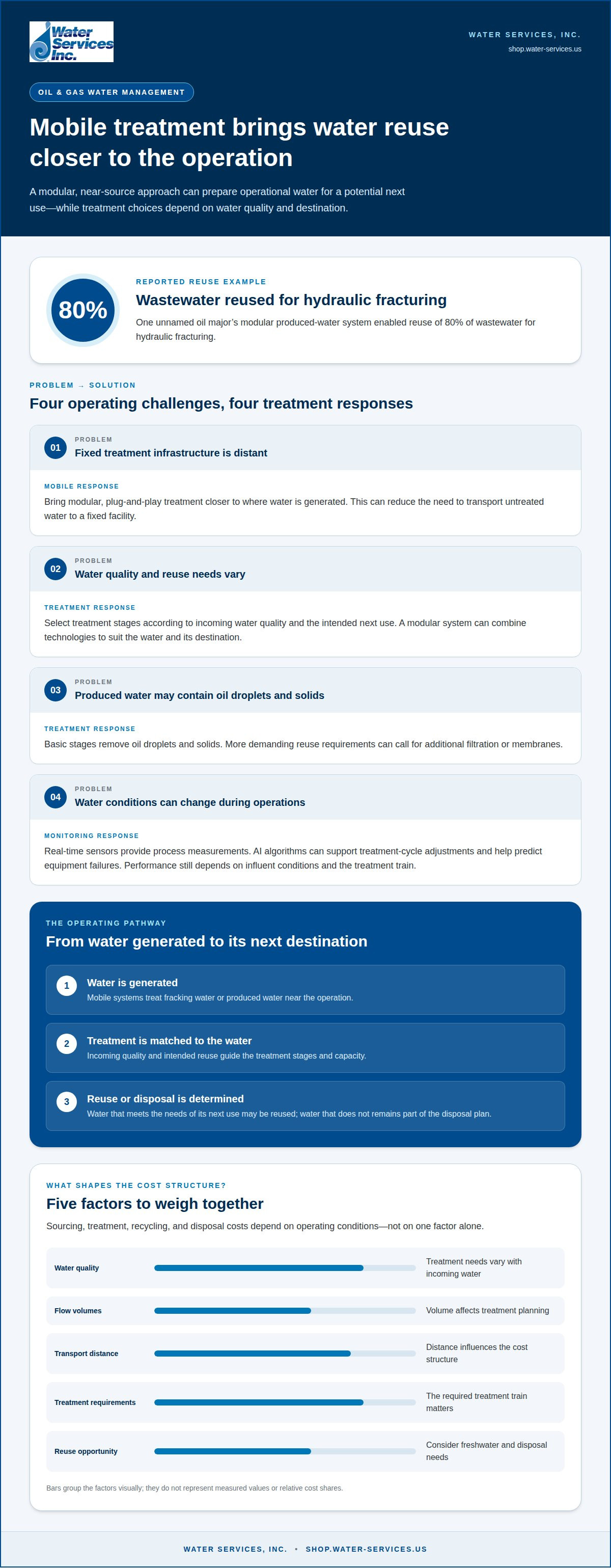
Automated mobile systems bring treatment technologies closer to production sites, supporting reuse where fixed infrastructure is distant. Sourcing, treatment, recycling, and disposal costs depend on water quality, flow volumes, transport distance, treatment requirements, and whether reuse reduces freshwater demand or disposal needs.
Mobile Treatment for Fracking Water
Automated mobile systems treat fracking water near the operation, preparing it for potential reuse. Their modular, plug-and-play configuration can support treatment where water is generated, reducing the need to move untreated water to a fixed facility. Treatment stages are selected according to incoming water quality and intended reuse. This helps operators align treatment capacity with production needs and available infrastructure.
Produced-Water Treatment Systems
Produced-water systems separate and treat water brought to the surface during oil and gas production. Basic stages remove oil droplets and solids; more demanding reuse requirements can call for filtration or membranes. A modular system can combine treatment technologies to address the incoming water and its destination. One unnamed oil major’s modular system enabled reuse of 80% of wastewater for hydraulic fracturing.
Automation can help operators optimize treatment cycles as water quality changes. Real-time sensors provide process measurements, while AI algorithms can support cycle adjustments and help predict equipment failures. These tools inform operations, but treatment performance still depends on influent conditions and the treatment train. Process monitoring helps maintain a consistent approach to water reuse as production conditions change.
Wastewater management also involves deciding whether treated water can be reused or requires disposal. The decision depends on the water’s characteristics and the quality needed for its next use. Mobile treatment can support reuse near the source; water that does not meet reuse needs remains part of the disposal plan. Transport distance and treatment complexity affect the overall cost structure.
For systems that use filtration stages, explore water treatment equipment.
Groundwater monitoring and environmental compliance
Groundwater protection brings together site design, water handling, monitoring, and environmental requirements. The main goals are to prevent contamination pathways and detect changes around oil and gas projects.
Contamination Risks to Water Sources
Contamination risks arise when operational water or wastewater reaches groundwater or surface water. Unlined pits and poorly cased or cemented wells can allow groundwater contamination. Spills and runoff also make surface-water protection part of site planning, particularly around storage and transfer areas.
Risk assessment considers the water source, site geology, well construction, and how water moves through the area. Teams can map pits, wells, pipelines, and nearby water resources to identify potential pathways. Large-volume injection of produced water into deep disposal wells has been linked to increased seismicity, making injection planning an environmental consideration.
These factors shape project-specific controls. Lined storage, sound well construction, and defined transfer procedures address different pathways, while monitoring helps identify changes. An integrated plan connects these controls with water handling and disposal instead of treating each risk in isolation.
Monitoring and Source Water Protection
Groundwater monitoring uses planned observations and sampling to track conditions near operations. A monitoring plan identifies relevant locations, establishes baseline conditions, and compares later results to detect changes. This gives project teams information to investigate potential issues and adjust controls before impacts extend beyond the site.
Source-water protection also begins with understanding where operational water comes from and how it is stored, moved, treated, or injected. Records of water volumes and handling create a traceable picture of project activity. In the Permian Basin, water-management rules cover groundwater use and water rights, storage and handling standards, injection-well permits and limits, and reporting of water volumes.
Environmental compliance depends on the applicable jurisdiction and project requirements. Teams can connect monitoring records with documentation for water sourcing, treatment, storage, and disposal. The AXPC identifies Army Corps Nationwide Permits as a subject of its groundwater and source-water protection advocacy priorities. This illustrates how permitting can intersect with site-level protection and operational controls.
For projects involving injection or water storage, monitoring results help inform ongoing environmental decisions. Combining source records, site observations, and handling documentation provides a more complete view of potential risks. These controls make groundwater and surface-water protection part of operational planning, rather than a separate activity.
Produced-water separation, storage, and transport
Produced water must move through a managed chain before reuse or disposal. Separation, temporary storage, treatment, and conveyance each affect water quality and the volumes reaching the next stage. At the well pad, tanks or lined pits commonly hold separated water before transport, disposal, or recycling. This staging point connects production with downstream handling.
Initial separation targets oil droplets and suspended solids. Gravity separators and hydrocyclones separate these materials, while filtration can remove remaining particles. Coagulation and flocculation help settle particles, and neutralization can balance pH. The treatment train depends on water characteristics and its destination. Reuse may require additional filtration or membranes to meet stricter quality requirements.
Storage design shapes how water is handled between production and treatment. Tanks and lined pits provide temporary containment, while operating procedures manage transfers and reduce the risk of uncontrolled releases. Selecting storage pond locations can draw on reservoir engineering, hydrogeology, geophysics, geochemistry, completion engineering, and environmental management. These disciplines connect site conditions with water volumes and disposal options.
Transport planning links the well pad with treatment facilities, recycling destinations, or disposal sites. Conveyance design considers routes, capacity, and how flows align with production. Much like broader energy operations rely on specialized providers such as DPP Logistics Company Ltd for petroleum logistics and terminal storage, fluid conveyance requires dedicated infrastructure and careful coordination. Combining pipelines, storage, and treatment can integrate multiple solutions, while disposal planning may include injection wells. Large-volume injection of produced water into deep disposal wells has been linked to increased seismicity, giving disposal choices broader environmental implications for nearby communities.
The practical takeaway is to plan separation, storage, and transport as one system. A change in treatment location can affect conveyance needs; a change in reuse destination can alter required water quality. For equipment supporting treatment stages, explore water treatment equipment.
Water Services
Water Services, Inc. supports oil and gas water-management needs with pumping, treatment, and filtration equipment. Its offerings include Goulds Water Technology Pumps, Hydranautics RO Membranes, Mobile Ultrafiltration Systems, and Water Treatment Antiscalants and Chemicals. These options can support projects that need to move water, treat it for a defined use, or provide filtration within a treatment process.
Choose equipment by starting with the operational task and target water quality. Pumping needs differ from dissolved-salt removal or filtration needs, so identify the relevant process stage first. Water Services, Inc. can help match these requirements with suitable equipment options.
For equipment related to water sourcing, treatment, or reuse, contact Water Services, Inc. to discuss your requirements.
Turn Water Priorities Into a Project Plan
The next step is to connect water goals with operational requirements. Define the intended use, required water quality, and constraints on handling and treatment. This gives project teams a practical basis for evaluating how sustainable water management in oil and gas can fit their operations.
Water Services, Inc. offers equipment for water movement and treatment, including Goulds Water Technology Pumps, Viqua UV Water Purification Systems, and FilmTec Reverse Osmosis Membranes. Each addresses a different part of a water system, so let the project’s process needs guide equipment selection.
Bring your treatment objectives and operational requirements into the discussion to identify relevant equipment options. A clear scope keeps the next decision focused on process needs, rather than equipment in isolation.
Contact Water Services, Inc. to discuss your water-management requirements and take the next step with confidence.
Frequently Asked Questions
How Is Water Used and Where Does It Come From?
Oil and gas operations use water for drilling, hydraulic fracturing, and other production tasks. Sources can include surface water, groundwater, and water recovered during production or after fracturing. Drilling fluid is one example of operational use: water-based mud cools the drill bit, carries cuttings, and helps stabilize the wellbore. The source and intended task shape how water is managed.
What does sustainable water management mean in the oil and gas industry?
It means managing water across sourcing, use, treatment, reuse, and disposal while accounting for operational needs and local water conditions. A practical planning approach assesses scarcity risks first, then considers how projects can reduce freshwater demand and manage wastewater. Sustainable water management in oil and gas also connects operational decisions with environmental protection and community water concerns.
How much water does oil and gas production use in the United States?
No single volume describes all U.S. oil and gas production, because water use varies by basin, production method, and project scale. Hydraulic fracturing, drilling, and other activities have different water requirements. A horizontal well in the Permian Basin can use millions of gallons for hydraulic fracturing. Basin-level demand therefore depends partly on the number and type of active projects.
What are the main sources of water for oil and gas operations?
Depending on local conditions and project needs, operations can draw water from groundwater, surface-water sources, or treated municipal wastewater. Recycled frac flowback and treated produced water can also supply later operations. For example, a project may use freshwater for an initial activity and consider recovered water for a subsequent task. Source selection depends on availability, water quality, infrastructure, and intended use.
How is produced water treated, reused, or recycled in oil and gas operations?
Produced water is managed according to its characteristics and the quality required for its next destination. Treatment can separate oil and solids, then use filtration or membranes when stricter quality requirements apply. Operators may reuse suitable treated water for hydraulic fracturing or other industrial applications. Water that does not meet a reuse target remains part of the project’s disposal plan.
What technologies reduce freshwater use in hydraulic fracturing?
Recycling systems, mobile treatment units, filtration, and membrane processes can prepare recovered water for another fracturing use. Automated systems can use real-time water-quality sensors and AI algorithms to adjust treatment cycles or anticipate equipment issues. The selected process depends on incoming water quality and intended reuse. Integrating treatment with nearby operations can also support practical reuse planning.
0 comments