

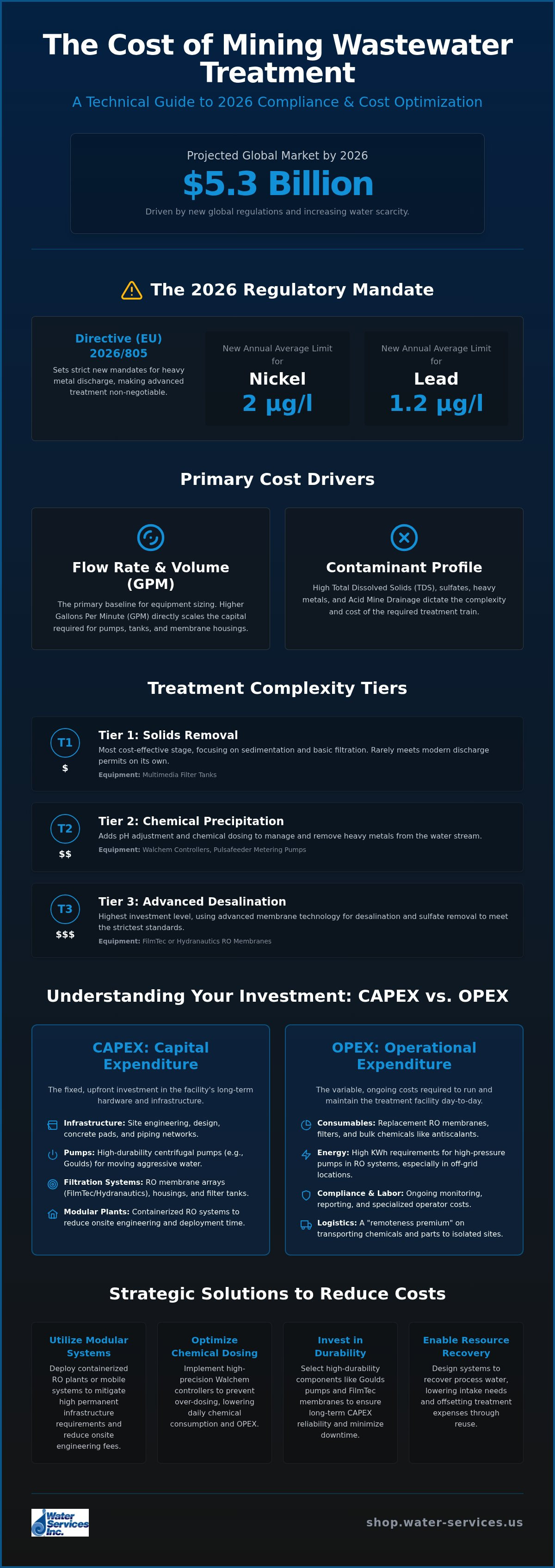
By the close of 2026, the global mining water treatment market is projected to reach $5.3 billion. This growth is fueled by the 2026 "Global Water Bankruptcy" declaration and strict new mandates like Directive (EU) 2026/805. You understand that the cost of mining wastewater treatment is no longer just a line item; it's a critical factor in site viability. Unpredictable chemical prices and the risk of regulatory fines for heavy metal discharge make traditional budgeting nearly impossible.
We've developed this guide to provide a comprehensive breakdown of primary cost drivers, equipment investments, and operational expenses. You'll learn how to lower your cost per gallon by recovering process water and leveraging modular infrastructure. We'll preview the specific CAPEX requirements for containerized RO plants and the OPEX advantages of high precision dosing with Walchem controllers and Goulds pumps. This technical analysis ensures your operation remains compliant through 2026 while optimizing your total cost of ownership. We'll examine how to balance initial hardware investments against the long-term reliability of industrial components.
Key Takeaways
- Identify how GPM capacity and specific contaminant profiles like TDS levels establish the foundational cost of mining wastewater treatment.
- Evaluate high-durability equipment procurement, including FilmTec RO membranes and Goulds centrifugal pumps, to ensure long-term CAPEX reliability.
- Optimize daily OPEX by implementing Walchem controllers for precise chemical dosing and calculating specific KWh requirements for high-volume filtration.
- Mitigate high permanent infrastructure requirements by utilizing modular, containerized RO plants or mobile ultrafiltration rental systems.
- Offset treatment expenses through resource recovery and ensure compliance with 2026 standards to avoid operational shutdowns and legal fees.
Primary Drivers of Mining Wastewater Treatment Costs
Calculating the total cost of mining wastewater treatment begins with an analysis of flow rate and volume. Gallons Per Minute (GPM) capacity serves as the primary baseline for equipment sizing. High-volume operations require larger footprints for Multimedia Filter Tanks and higher-capacity Goulds centrifugal pumps. When GPM increases, the capital requirement for pressure vessels and membrane housings scales proportionally. Smaller modular systems offer lower entry costs but may lack the throughput efficiency required for large-scale tailings management.
The contaminant profile of the influent water dictates the complexity of the treatment train. High levels of Total Dissolved Solids (TDS), sulfates, and heavy metals necessitate multi-stage processing. Acid mine drainage remains a significant driver of expense due to its corrosive nature and high metal loading. These chemical characteristics require specialized water treatment chemicals and corrosion-resistant components to prevent premature equipment failure. Stricter 2026 standards, such as Directive (EU) 2026/805, now mandate annual averages as low as 2 µg/l for Nickel and 1.2 µg/l for Lead. Meeting these precise thresholds forces a shift from basic sedimentation to advanced membrane technologies.
Contaminant Complexity and Treatment Tiers
Treatment costs are structured into three distinct tiers based on water quality goals. Tier 1 involves simple solids removal using multimedia filter tanks and sedimentation. It's the most cost-effective stage but rarely meets modern discharge permits. Tier 2 adds chemical precipitation and pH adjustment. This requires Pulsafeeder metering pumps and Walchem controllers to manage heavy metal removal. Tier 3 represents the highest investment level, utilizing advanced desalination and sulfate removal through FilmTec or Hydranautics reverse osmosis membranes. Each tier increases both the initial CAPEX and the ongoing demand for consumables.
The Impact of Site Remoteness on Lifecycle Costs
Geographic location significantly influences the cost of mining wastewater treatment through logistics and energy constraints. Transporting replacement RO membranes and bulk antiscalants to remote basins adds a "remoteness premium" to every gallon treated. Off-grid environments often rely on diesel-generated power, making the energy-intensive operation of high-pressure RO systems a major OPEX burden. Mining-Influenced Water (MIW) refers to any water whose chemical composition has been altered by mining activities; its typical treatment cost variables include the net acidity of the stream and the specific concentration of dissolved toxic elements. Using pre-designed containerized units reduces onsite engineering fees and simplifies the logistics of remote deployment.
CAPEX: Capital Investment for Mining Water Infrastructure
Capital expenditure for mining water management represents the most significant financial hurdle in the project lifecycle. The initial cost of mining wastewater treatment encompasses everything from hardware procurement to site engineering. Unlike operational costs which fluctuate based on throughput, CAPEX is a fixed investment in the facility's long-term durability. According to the EPA guide on mine site remediation costs, engineering and design fees can represent a substantial portion of the total project budget, especially when addressing complex acid rock drainage scenarios. Site preparation for permanent plants requires concrete pads, extensive piping networks, and electrical integration, all of which add to the primary investment.
Core Equipment Costs and Selection
Selecting high-durability components is essential for minimizing future failure rates. Industrial pump selection should focus on reliability in high-head, high-flow environments. Goulds Water Technology pumps are the industry standard for these applications due to their ability to move aggressive Mining-Influenced Water. Sizing filtration housings and multimedia tanks requires precise calculations based on peak GPM requirements. For the reverse osmosis stage, operators must evaluate FilmTec vs. Hydranautics membranes. FilmTec often provides superior rejection rates for specific heavy metals, while Hydranautics offers high-efficiency throughput for high-volume TDS removal. You can source these specialized components through our industrial water treatment collection to ensure system compatibility.
Modular vs. Permanent Infrastructure
The choice between a permanent facility and modular infrastructure significantly impacts the cost of mining wastewater treatment. Permanent infrastructure involves long-term construction and high on-site labor costs. Conversely, containerized reverse osmosis plants offer factory-tested reliability and rapid deployment. These modular units arrive pre-wired and pre-plumbed, reducing the need for expensive on-site engineering. Integrating Walchem controllers and Signet flow sensors into these modular plants allows for automated oversight. This automation reduces long-term labor requirements and ensures the system operates within its designed technical specifications. Modular systems also provide the flexibility to scale capacity as mine production increases, avoiding the risk of over-investing in oversized permanent infrastructure early in the project.
OPEX: The Ongoing Cost of Mining Water Management
Operational expenditure often represents the most significant portion of the total lifecycle cost of mining wastewater treatment. While CAPEX is a one-time hurdle, OPEX is a continuous demand for resources that fluctuates with production levels. Over a 15-year period, the operational costs of a standard 1,000 m³/day reverse osmosis plant can reach 2 to 3 times the initial capital investment. This ongoing expense is comprised of energy consumption, chemical consumables, technical labor, and recurring maintenance cycles. Managing these variables requires a shift from reactive repairs to data-driven operational control.
Energy consumption is typically the largest single OPEX driver for high-pressure membrane systems. The KWh required to push water through FilmTec or Hydranautics membranes at high flux rates scales with the Total Dissolved Solids (TDS) concentration. In remote, off-grid basins where diesel generators provide power, the cost per kilowatt-hour is significantly higher than in grid-connected regions. Efficient pumping is critical. Utilizing correctly sized Goulds centrifugal pumps ensures the system operates at the highest possible hydraulic efficiency, which directly lowers the daily power draw.
Optimizing Chemical Dosing Costs
Mining water often carries a high risk of mineral scaling and biological fouling. Managing this requires a steady supply of water treatment chemicals, including antiscalants, coagulants, and pH adjusters. Precision dosing reduces annual OPEX by 15-20% by eliminating chemical waste and extending membrane service life. We recommend using Pulsafeeder metering pumps paired with Walchem controllers to automate this process. These systems adjust chemical delivery based on real-time sensor data. This prevents the expensive over-dosing that occurs with manual calibration and protects the integrity of your membrane array.
Membrane and Filter Replacement Strategies
The total cost of ownership for a treatment plant includes the frequent replacement of sediment and carbon filters. These pre-filtration components protect more expensive downstream equipment from physical damage. Membrane fouling cycles eventually necessitate the replacement of reverse osmosis elements, but Cleaning-in-Place (CIP) protocols can defer these costs. By circulating specialized cleaning solutions through the RO array, operators can restore flux rates and delay the purchase of new membranes. When mechanical failures occur, sourcing Goulds maintenance parts or replacement impellers quickly is essential to avoid the high cost of operational downtime. Technical oversight and water quality reporting also contribute to labor costs, though automated monitoring through Signet flow sensors can reduce the need for constant manual site presence.
Hidden Costs: Compliance, Risk, and Resource Recovery
The financial risk of non-compliance often exceeds the direct hardware investment. Regulatory fines, legal fees, and forced operational shutdowns create a volatile cost of mining wastewater treatment that many operators fail to budget for. With the 2026 "Global Water Bankruptcy" declaration, international pressure on mining sustainability has intensified. Implementing Zero Liquid Discharge (ZLD) systems requires significant initial CAPEX. However, ZLD eliminates discharge fees and minimizes the environmental risk that leads to costly litigation. While the upfront investment is high, ZLD systems typically offer a payback period of 3 to 5 years by eliminating the need for external discharge permits.
Resource recovery provides a direct method to offset treatment expenses. By extracting valuable metals from wastewater streams, mines can transform a waste management burden into a revenue source. This process relies on advanced membrane separation and chemical precipitation. High-purity RO systems facilitate process water reuse. This reduces the intake volume of raw freshwater, which is increasingly expensive in water-stressed regions. Effective dewatering also reduces the long-term maintenance costs of tailings ponds by minimizing the volume of liquid waste that requires storage and monitoring.
Regulatory Navigation and 2026 Standards
Compliance in 2026 requires precise data logging. Budgeting for continuous water flow meter GPM monitoring is now a mandate rather than an option. Using Signet flow sensors and Walchem controllers allows for real-time reporting to satisfy EPA and international discharge limits. Evolving standards like Directive (EU) 2026/805 set strict annual averages for substances like Nickel and Lead. Failure to track these metrics can result in immediate permit revocation. For a deeper look at balancing these requirements, read our guide on Mining Wastewater Treatment Solutions. This technical oversight ensures that your site stays operational despite tightening environmental constraints.
The ROI of Water Recovery
The return on investment for water recovery systems is calculated by comparing the cost per gallon of recycled water against freshwater intake and discharge fees. Advanced RO systems using FilmTec membranes often pay for themselves through internal reuse alone. By integrating high-efficiency membranes, you can recover up to 90% of process water for reuse in ore processing or dust suppression. This strategic approach stabilizes the cost of mining wastewater treatment across the entire site lifecycle by reducing reliance on external water sources. It's a proactive measure that mitigates the operational risk associated with local water scarcity and fluctuating utility prices.
If you need to upgrade your monitoring capabilities to meet 2026 standards, browse our selection of industrial controllers and sensors to ensure accurate GPM reporting.
Strategic Solutions to Reduce Mining Water Costs
Optimizing the total cost of mining wastewater treatment requires a shift from traditional, permanent infrastructure toward flexible, modular solutions. High-end components like Goulds pumps and FilmTec membranes provide the durability needed for harsh environments, but how you procure and deploy them determines your final ROI. By utilizing standardized designs and remote monitoring, operators can bypass the high fees associated with custom engineering and manual site oversight. These strategies allow for a more predictable budget in an industry often plagued by fluctuating operational expenses.
Mobile ultrafiltration systems and containerized RO plants offer a strategic advantage for remote basins. These units are factory-tested and ready for immediate integration, which significantly reduces on-site labor and assembly time. Direct sourcing through specialized industrial platforms further lowers component costs by eliminating the markups typically added by regional middlemen. This direct-to-site approach ensures that you receive verified industrial hardware without the logistical delays common in traditional procurement cycles.
Mobile Treatment Units for Rapid Deployment
Renting mobile water treatment plants is an effective strategy to avoid high upfront CAPEX during short-term mining projects or pilot studies. Mobile ultrafiltration systems are particularly useful for emergency response when existing infrastructure fails or when sudden fluctuations in water quality occur. These systems provide immediate relief without the long lead times of permanent construction. Integrating automation and remote monitoring sensors into these mobile units ensures that water quality remains within permit limits even in the absence of a full-time technical crew. This flexibility is essential for maintaining compliance while keeping the cost of mining wastewater treatment manageable during variable production phases.
Procurement Efficiency for Mine Operators
Consolidating your supply chain is a proven method for reducing administrative overhead and shipping costs. Sourcing your Goulds pumps, replacement membranes, and water treatment chemicals from a single distributor simplifies logistics for remote sites. This vendor consolidation ensures that all system components are technically compatible, reducing the risk of downtime caused by mismatched hardware. You should also consider the impact of high-quality PPE on your long-term budget. Reliable safety gear reduces the risk of expensive workplace injuries and the associated insurance premiums or operational downtime.
Strategic water management isn't just about selecting the cheapest hardware. It's about building a system that balances initial investment with long-term operational stability. Contact Water Services for a custom mining water cost analysis to identify specific efficiency gains for your site.
Optimizing Your 2026 Mining Water Strategy
Managing the total cost of mining wastewater treatment requires a precise balance between durable hardware and automated operational control. By 2026, the shift toward modular infrastructure and resource recovery will define the most profitable operations. You've seen how containerized RO plants reduce initial engineering fees while Walchem controllers minimize chemical waste. These technical improvements don't just ensure compliance; they stabilize your long-term budget against market volatility. It's about moving from a reactive maintenance model to a proactive, data-driven system that preserves your license to operate.
Water Services provides the industrial expertise and authorized components needed to secure your site's future. We specialize in custom-designed containerized RO plants and serve as an authorized distributor for industry leaders like Goulds, FilmTec, and Viqua. Our team brings global installation experience from projects across Africa and South America, ensuring that your equipment performs in the most demanding remote environments. We understand the rigors of industrial water management and the importance of logistical reliability.
Request a Custom Engineering Quote for Your Mining Operation to begin optimizing your water lifecycle. We're ready to help you achieve technical integrity and operational efficiency.
Frequently Asked Questions
What is the average cost per gallon for treating mining wastewater?
The cost of mining wastewater treatment per gallon depends on influent TDS levels and the required discharge purity. While specific rates vary by site, industrial averages often reflect the complexity of removing heavy metals and sulfates. High-volume operations benefit from economies of scale, but the presence of acid mine drainage significantly increases the chemical demand and the associated cost per unit of treated water.
How does Zero Liquid Discharge (ZLD) affect the total cost of a mining project?
Implementing Zero Liquid Discharge (ZLD) increases initial CAPEX due to the need for advanced evaporators or high-recovery RO arrays. However, it lowers long-term operational risk by eliminating discharge permit fees and the potential for environmental fines. Many mining operations report a payback period of three to five years, as the system offsets the expense of freshwater intake and waste management.
Is it cheaper to rent or buy a mobile water treatment plant for a mine?
Choosing to rent a mobile water treatment plant is typically more cost-effective for short-term remediation or pilot projects. It allows operators to treat the expense as OPEX rather than a major capital investment. Buying is preferred for permanent installations where the long-term lifecycle cost of ownership is lower than recurring rental fees. Containerized plants provide a middle ground for rapid, flexible deployment.
What are the primary maintenance costs for an industrial reverse osmosis system?
Maintenance for an industrial reverse osmosis system focuses on membrane replacement cycles and pre-filtration media. Sediment and carbon filters require frequent changing to protect the RO elements from fouling. Mechanical maintenance includes pump seal replacements for Goulds units and calibration of Walchem controllers. Regular Cleaning-in-Place (CIP) protocols are essential to extend the functional life of membranes and maintain design flux rates.
How much can a mine save by reusing treated wastewater?
A mine can significantly reduce its operational budget by reusing treated wastewater for ore processing and dust suppression. This practice lowers the "cost per gallon" of the total water lifecycle by reducing reliance on external freshwater sources. Effective water recovery also minimizes the volume of liquid waste sent to tailings ponds, which reduces long-term maintenance and closure liabilities for the site.
What chemicals are most expensive in the mining water treatment process?
Antiscalants and coagulants often represent the highest chemical expenses in the treatment train. These specialized formulas are critical for preventing membrane scaling and ensuring effective solids removal. The price of these consumables fluctuates based on global supply chains. Using Pulsafeeder metering pumps ensures precise delivery, preventing the financial waste associated with manual over-dosing or inconsistent chemical application.
Can automation reduce the labor costs of wastewater treatment?
Automation through Walchem controllers and Signet flow sensors directly reduces the technical labor hours required for site oversight. These systems provide real-time data logging and remote monitoring, which eliminates the need for constant manual sampling and adjustments. By automating chemical dosing and system troubleshooting, mines can maintain 2026 compliance standards with a smaller on-site technical team, lowering the overall cost of mining wastewater treatment.
How do 2026 environmental regulations impact treatment budgeting?
New standards like Directive (EU) 2026/805 mandate lower thresholds for heavy metals, which forces mines to invest in Tier 3 treatment technologies. Budgeting must now account for higher CAPEX for reverse osmosis and ultrafiltration systems. Additionally, the 2026 "Global Water Bankruptcy" state has increased the cost of freshwater intake, making the financial case for resource recovery and high-efficiency treatment equipment more urgent than in previous years.
0 comments