

The most advanced wash-water treatment train isn’t automatically the right fit for your bay. The right industrial wastewater recycling system depends on what the wastewater contains and the quality needed for reuse. Soil, oils, detergents, and wash processes all affect treatment requirements.
Start by defining wastewater characteristics and the intended reuse quality using representative sampling and site data, not assumptions. A mismatch between treatment stages and reuse goals can affect water quality, while an installation that doesn’t account for site layout and connections can complicate wash-bay operations.
This 2026 buying guide explains how to compare treatment stages and system configurations against actual operating conditions. It covers flow, influent variability, reuse goals, space, and integration with existing equipment. You’ll also learn how modular or mobile approaches, including ultrafiltration, may fit a site-specific project. Use these criteria to evaluate a vehicle wash-bay water recycling system before specifying equipment.
Key Takeaways
- Assess wash-bay wastewater separately from general industrial or domestic wastewater to define treatment requirements accurately.
- Use sampling results and the intended reuse quality to determine which treatment stages an industrial wastewater recycling system may need.
- Compare fixed, modular, and mobile configurations by footprint, deployment needs, and connections to existing site infrastructure.
- Build an engineering-ready brief with flow patterns, wash chemistry, operating schedules, solids or oil observations, and system interfaces.
- Water Services designs modular treatment systems for industrial wastewater-management needs, using site data to shape the project scope.
Vehicle Wash Bay Water Recycling Systems: What They Treat and Why
A vehicle wash-bay recycling system treats wastewater to a defined quality for reuse. It collects selected wash-water flows, reduces contaminants through suitable treatment stages, and returns treated water to an intended use. An industrial wastewater recycling system for a wash bay must reflect the site’s water sources and reuse target, not a generic assumption about what “wash water” contains.
Wash-bay wastewater differs from domestic sewage, which comes from uses such as toilets and sinks. It also differs from industrial process water, whose contaminants depend on the materials being manufactured or handled. Vehicle wash water may contain road soil, oils, detergents, and suspended solids. The amounts and proportions vary with vehicle condition, wash chemistry, equipment, and operating practices. For a broader overview of industrial wastewater processes and disposal methods, see Industrial Wastewater Treatment.
Recycling treats wastewater to a defined quality for reuse; treatment followed by discharge conditions water for release rather than return to a process. The distinction matters when setting project goals. Reuse may help manage wastewater volume and reduce reliance on freshwater, but the design must account for the required water quality and any separate discharge route.
Which vehicle wash-bay water streams need evaluation?
Map where water enters and leaves each operation. Potential wash-water sources include pre-rinse, detergent wash, rinse, and equipment-cleaning activities. Don’t assume every bay or wash stage produces the same wastewater. A rinse flow may differ from water used to remove heavy soil, while equipment cleaning may introduce concentrated residues or solids.
Record what you observe and where it originates. Soil, oils, detergent residues, and suspended solids can vary with the process and vehicle mix. This source-by-source view helps determine whether flows should be collected together or evaluated separately. It also makes sampling more useful: document each sample’s collection point and the operating conditions at the time.
Keep stormwater and sanitary flows distinct from wash-bay process water in the project assessment. Map drains, collection points, and connections so the design basis reflects the actual site layout.
What does the intended reuse application determine?
Define the destination before selecting treatment. Water returned to a wash-process stage has a different purpose from water directed to another site use or treated for discharge. Each destination needs a defined water-quality target based on process requirements and applicable site conditions. Don’t assume recycled wash water is potable or suitable for every use.
Specify which operation will receive the water, how consistently it must be available, and which water-quality characteristics matter for that use. This gives engineers a basis for matching influent characteristics to treatment requirements. It also helps avoid adding stages that don’t serve the application or overlooking a requirement that could limit reuse.
How an Industrial Wastewater Recycling System Treats Wash-Bay Water
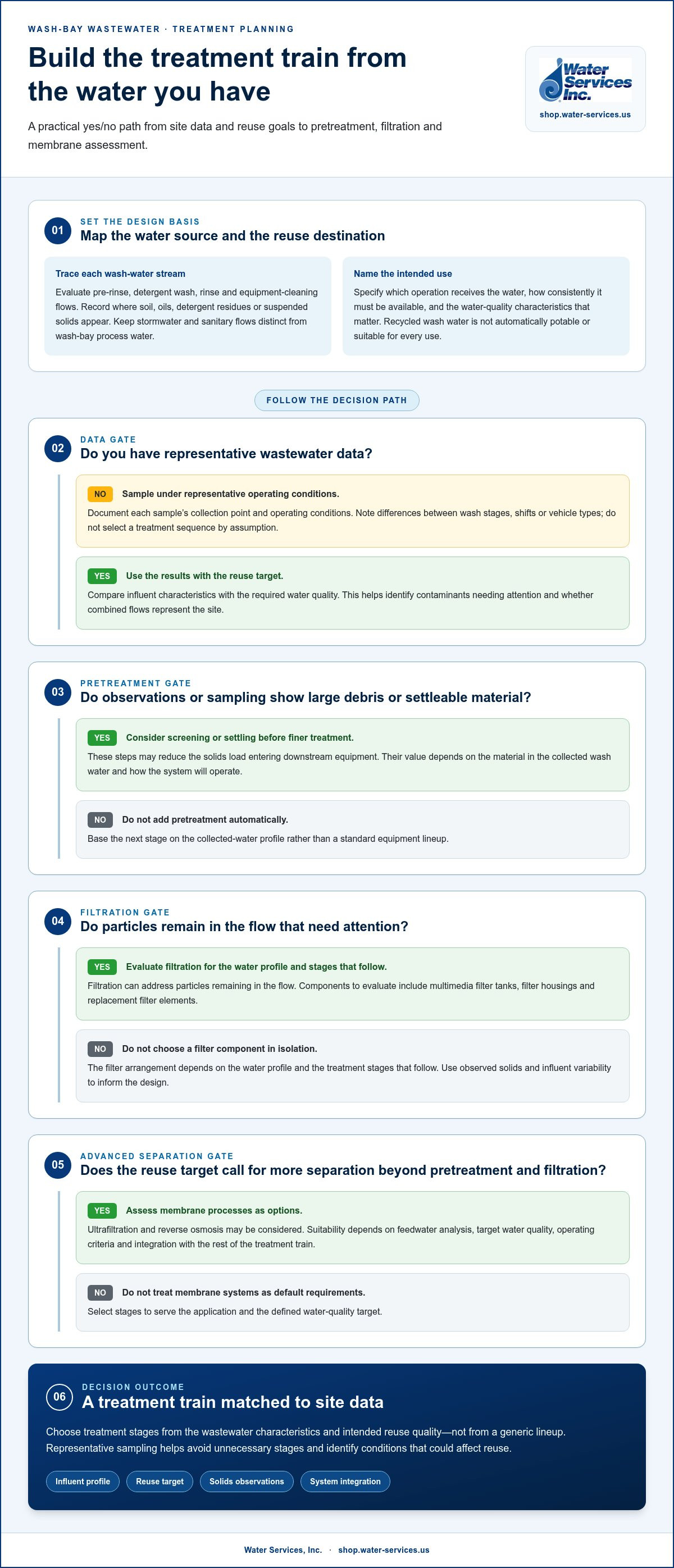
A treatment train uses stages selected for the wastewater and reuse target. Begin by characterizing the influent, then identify any pretreatment needs, filter particles as appropriate, and assess whether advanced treatment is needed. Select an industrial wastewater recycling system based on feedwater characteristics and intended reuse quality, rather than a standard equipment lineup.
Sampling helps establish the design basis. Evaluate wastewater under representative operating conditions and note differences between wash stages, shifts, or vehicle types. Results can help engineers identify which contaminants need attention and whether a combined flow represents the site. Selecting a sequence without this information can add unnecessary stages or miss a condition that affects reuse.
How do pretreatment and filtration fit the treatment train?
If observations or sampling indicate large debris or settleable material, screening or settling may be considered before finer treatment. These steps can reduce the solids load entering downstream equipment. They aren’t automatic requirements: their value depends on the material in the collected wash water and how the system will operate.
Filtration can address particles that remain in the flow. The filter arrangement depends on the water profile and the stages that follow. Multimedia filter tanks, filter housings, and replacement filter elements are examples of components to evaluate as part of a treatment design. Explore industrial water-treatment equipment as part of the complete process, rather than choosing a component in isolation.
For planning, document where solids appear, whether they settle, and how much the influent varies. These observations help inform filtration needs and maintenance access. They also support decisions about collection, pumps, and connections between treatment stages.
When should membrane treatment be considered?
Consider membrane processes when the reuse target calls for additional separation beyond the selected pretreatment and filtration steps. Ultrafiltration and reverse osmosis are options to assess, not default requirements. Their suitability depends on feedwater analysis, target water quality, operating criteria, and integration with the rest of the treatment train.
For example, if a site is considering water for a particular rinse stage, set a target based on that operation, then assess whether filtration is sufficient or further treatment is warranted. A different reuse destination can require a different design basis. Don’t assume that adding a membrane makes water suitable for every use or that one membrane process fits all wash bays.
Integration matters as much as the treatment step. Account for flow paths, controls, pumps, filter changes, and access for routine service when laying out the system. Water Services designs modular treatment systems for industrial wastewater-management needs, with project scope shaped by site influent, reuse goals, and system interfaces. Review water-treatment equipment and components in light of those requirements.
Compare Wash-Bay Recycling System Configurations Before You Buy
Configuration affects more than equipment location. It shapes how treatment connects to wash operations, how much site preparation may be needed, and how the system can adapt if project requirements change. Configuration depends on site duration, available space, and treatment requirements. Compare these factors alongside influent data and reuse objectives before narrowing the design.
| Configuration | Best-fit conditions | Advantages | Design questions |
|---|---|---|---|
| Fixed | Established wash bays with a defined, ongoing treatment location. | Can be arranged around existing site utilities and collection points. | Where will equipment sit, and how will piping connect to wash operations? |
| Modular | Projects where equipment layout, phased deployment, or future adjustments are key considerations. | Allows treatment components to be considered as a coordinated arrangement. | Which stages should be grouped, and what space and service access do they require? |
| Mobile | Projects where temporary use, relocation, or a non-permanent setup is being assessed. | May provide an alternative to placing all treatment equipment in a fixed installation. | How will collection, power, water connections, and operating responsibilities work at each location? |
When might a modular or containerized arrangement fit?
Evaluate modular design when the site needs a coordinated treatment layout or implementation may be phased. Account for the sequence of treatment stages, access for operation and maintenance, and connections to the wash bay. “Modular” alone doesn’t establish a system’s footprint or performance; those depend on project-specific design data.
Containerized reverse osmosis plants are another equipment category to consider, including for constrained or remote sites. Their suitability depends on the treatment objective, site layout, feedwater, and integration needs. Mobile ultrafiltration systems are also an option to evaluate. Match either approach to the application and project requirements rather than assuming it is suitable.
How should purchase, rental, and integration needs be compared?
Compare purchase and rental scenarios against the expected project duration and the responsibilities the site will retain. Consider who will manage routine operation, consumables, maintenance, and any relocation or return requirements. These operating details can affect the preferred arrangement, even when two configurations appear to meet the same treatment objective.
Give integration equal attention. Document wastewater collection points, available space, utilities, connection locations, and the wash equipment the treatment system must serve. Clarify how treated water will return to its reuse point and how operators will access filters or other serviceable components. The role of filtration can also inform configuration: compare relevant industrial water-treatment equipment as part of the complete design, not as stand-alone selections. A project brief that covers these interfaces gives engineers a practical basis for comparing fixed, modular, and mobile approaches.
Build a Wash-Bay System Specification from Site Data
A useful system specification turns site observations into design inputs. It shows how wastewater is generated, what quality the reuse application requires, and how treatment equipment can connect to wash-bay operations. Before specifying an industrial wastewater recycling system, gather wastewater sources and flow variation, representative sampling results, wash chemicals, reuse targets, available space, utilities, and process interfaces.
Build the brief in sequence. Each step informs the next and keeps the engineering review focused on actual site conditions.
- Map flows. Identify wastewater collection points, wash stages, equipment-cleaning flows, and changes in flow during the operating schedule. Distinguish stormwater and sanitary flows from process wastewater.
- Sample wastewater. Arrange representative sampling under documented operating conditions. Record relevant physical and chemical characteristics, including visible solids, oil, or changes in water appearance.
- Define the reuse target. State where treated water will be used and identify the water-quality criteria relevant to that application. Document separate discharge intentions, if applicable.
- Assess space. Mark potential equipment locations, access routes, service clearances, and available space for collection or treatment tanks.
- Document interfaces. Record piping routes, electrical supply, controls, connection points, and how treated water will return to the process.
What wastewater and operating data should buyers collect?
Pair the flow map with operating context. Record hours and schedules, periods of higher or lower activity, vehicle or process changes, and wash stages running at the same time. List detergents and other wash chemicals in use, along with observed variation in solids or oil. Record each sample’s collection location and operating conditions so the design team can interpret results against actual process activity.
If conditions change across shifts or wash modes, note those differences rather than relying on one assumed operating pattern. This record helps determine whether the system should be designed around typical conditions, changing influent, or defined operating scenarios.
What should the installation and operating plan address?
The site brief should cover electrical supply, controls, tank and piping locations, and access for inspection and routine maintenance. Include residuals handling, monitoring responsibilities, and the staff roles involved in operating the system. Identify whether a bypass or alternate flow route is needed during maintenance or interruptions, and describe how it would function without assuming a particular configuration.
Discharge and reuse requirements vary by jurisdiction and application. Identify the requirements that apply to the project location and establish clear boundaries for reuse and any discharge pathway before final equipment selection. A well-documented brief gives the design process a practical foundation. Use your site data to develop a wash-bay treatment project brief around the required treatment and integration needs.
Plan a Custom Vehicle Wash Bay Water Recycling Project with Water Services
A well-defined project begins with site information, not an equipment list. Water Services designs modular treatment systems for industrial wastewater-management needs. For a vehicle wash bay, documented influent, reuse targets, and integration requirements shape the project scope before treatment components are selected. This approach connects process needs with practical layout and operating considerations.
Prepare a concise project brief that captures how the wash bay runs and what the recycling system must support. Include:
- Wash processes and wastewater sources: Identify wash stages, equipment-cleaning flows, and collection points.
- Flow and schedule: Describe flow patterns, operating hours, and changes in activity or process conditions.
- Water-quality information: Include representative sampling results and observations about solids, oil, and wash chemistry.
- Reuse destination: State where treated water is intended to go and the quality criteria for that application.
- Site and system interfaces: Document available space, utilities, piping routes, collection tanks, controls, and service access.
- Project location: Identify the site geography and applicable discharge or reuse requirements for design review.
These details help distinguish required treatment from optional stages and define how equipment must connect to the facility. Discharge and reuse requirements depend on the project jurisdiction and application, so identify those boundaries without assuming compliance before they’re reviewed.
How can buyers move from system criteria to equipment review?
Once treatment stages and interfaces are documented, review equipment by function. Consider how pumping supports flow between collection, filtration, and reuse points. Water Services offers industrial pumps alongside filtration and treatment components, so buyers can evaluate equipment in the context of the planned system rather than as isolated selections.
Water Services offers mobile ultrafiltration systems and containerized reverse osmosis plants. Evaluate them against the project’s influent data, reuse target, site constraints, and operating requirements. Neither option is suitable for every wash bay; selection depends on the design basis and intended role in the treatment train.
A project scope can clarify which elements need to be integrated, where equipment will be located, and what operating responsibilities must be planned. Water Services uses modular treatment approaches for industrial wastewater-management needs, with system planning tied to site requirements. Bring together sampling results, the flow map, reuse objectives, and interface notes before reviewing equipment options.
To move the project forward, explore Water Services industrial water-treatment equipment and organize the site data that will guide planning and equipment selection.
Turn Your Site Requirements into a Practical Next Step
Before procurement, align the project team around one clear design basis. Confirm who is responsible for sampling, site measurements, reuse criteria, and jurisdictional review, then keep those inputs together as the scope develops. This gives equipment decisions a traceable starting point and keeps the selected industrial wastewater recycling system connected to the wash bay’s operating needs.
Water Services, Inc. has supported industrial water-treatment needs since 1994. Use documented site conditions to begin a focused equipment review, with project requirements guiding the discussion rather than a preselected treatment train.
Explore Water Services industrial water-treatment equipment and take the next step toward a wash-bay project plan built around your site.
Frequently Asked Questions
Can recycled wash-bay water be reused in every vehicle wash stage?
No. Treated water may suit one wash stage but not another. For example, water intended for an earlier wash step shouldn’t automatically be routed to final rinsing. Define the destination for each proposed reuse stream and set a quality target for that use. Review test results under representative operating conditions before making a connection, especially if wash chemistry or incoming soil varies over time.
How much wastewater can a vehicle wash-bay recycling system recover?
There’s no universal recovery figure for every wash bay. For an industrial wastewater recycling system, estimate recovery using a site-specific water balance: measure collected influent, water returned to the process, and flows that leave as residuals or otherwise aren’t reused. Compare measurements across representative operating periods. Treat projected recovery as a design estimate, not a guaranteed result, and document the assumptions behind any system comparison.
Does a vehicle wash-bay recycling system remove oil and grease?
Specific treatment steps may be needed, depending on the oil or grease present and how it behaves in the wash water. Free oil and detergent-mixed residues can respond differently to treatment. Use sampling and process review to identify the condition before deciding whether separation or other pretreatment should be assessed. A general filtration description alone doesn’t establish removal performance for a particular contaminant or target.
Do wash-bay water recycling systems require discharge permits?
Permit obligations depend on the facility, location, discharge destination, and applicable rules. Identify where the water would go and review the requirements that apply before designing a discharge route. Reuse plans can also have site-specific requirements. Don’t treat a general description of permit rules as a determination for your facility; obtain a project-specific review before finalizing the plan.
Can a recycling system work with existing wash-bay equipment?
Integration depends on the site and wash process. Check whether existing collection points, piping routes, electrical supply, and controls can support the proposed connections. Plan how installation and commissioning will fit around wash operations, including any needed isolation or temporary operating arrangements. A documented tie-in plan can surface conflicts before equipment placement and help reduce avoidable disruption during implementation.
How often does a vehicle wash-bay water recycling system need maintenance?
There’s no single maintenance interval for every system. Follow the equipment manufacturer’s instructions and use operating records to set site procedures. Track indicators such as flow changes, pressure readings, water-quality results, and filter or membrane service history where applicable. Assign responsibility for inspections, residuals handling, and recordkeeping. Review the schedule when influent conditions, operating hours, or wash processes change, rather than relying on a fixed interval for all sites.
0 comments