

Could water that looks clean still be unsuitable for concrete mixing? Yes. Appearance and potable-water status don’t always provide the documented acceptance a project requires. Understanding water for concrete mixing quality standards starts with identifying the governing specification, then matching the water source to its testing and recordkeeping requirements.
Acceptance depends on the project specification and the evidence it requires. This article explains how to evaluate potable, non-potable, and recovered water, and how to interpret test results without treating one result as blanket approval. It covers ASTM C1602/C1602M-22, including strength and setting-time performance criteria and optional chemical limits, alongside the importance of checking project references. You’ll also find practical steps for sampling, documenting results, and determining whether source-water treatment may be needed before production.
Key Takeaways
- Identify the governing project specification before evaluating a water source, since it sets the acceptance criteria.
- Use the right evidence for municipal, groundwater, process, or recovered water, and clarify who reviews and approves it.
- Follow a documented workflow for sampling, laboratory testing, results review, and production release.
- Use water for concrete mixing quality standards to assess source variability and potential effects on concrete performance.
- Base treatment choices on source-water analysis and the project’s target requirements, then verify treated water as specified.
Water for Concrete Mixing: What Quality Standards Actually Govern?
Water for concrete mixing quality standards set out how water intended for hydraulic cement concrete production is evaluated and what evidence supports its acceptance. The criteria don’t come from appearance or a single rule that applies to every job. They come from the governing project documents, including the specified standard, contract requirements, and referenced provisions.
Visual clarity alone cannot establish compliance with a technical specification. Clear water may contain dissolved substances that need evaluation, while water that looks different isn’t automatically unsuitable. The project’s acceptance route determines whether source classification, test results, or other documented evidence is required. This keeps assumptions from replacing a traceable quality decision.
What ASTM C1602/C1602M covers
ASTM C1602/C1602M is titled Standard Specification for Mixing Water Used in the Production of Hydraulic Cement Concrete. As of October 2026, the current edition identified here is ASTM C1602/C1602M-22. It provides a framework for mixing-water requirements and is used alongside project specifications and other referenced requirements, not in place of them.
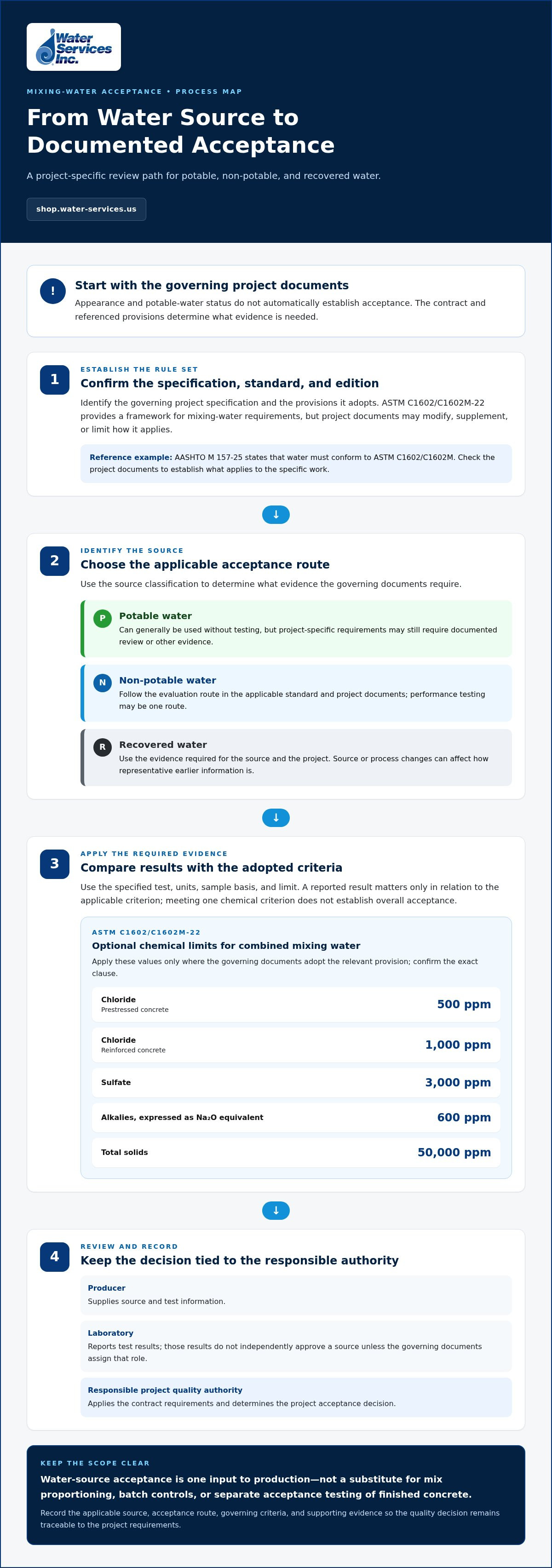
Before applying a criterion, confirm which edition and clauses the contract or governing specification adopts. A referenced standard may be modified, supplemented, or applied only to particular water sources or tests. For example, AASHTO M 157-25, which covers ready-mixed concrete, states that water must conform to ASTM C1602/C1602M. The project documents establish what applies to a specific placement.
Does potable water automatically meet project requirements?
Potable water can generally be used for concrete without testing, but that general route doesn’t override project-specific requirements. A contract may require documented review, identify an adopted standard, or specify evidence for the source. Confirm the required documentation and acceptance authority before production rather than relying on drinking-water classification alone.
For non-potable or recovered sources, the applicable standard may provide a different evaluation route, such as performance testing. The decision belongs within the project’s quality process. The producer supplies source and test information, and the responsible project quality authority applies the contract requirements. A laboratory reports results, but those results don’t independently approve a source unless the governing documents assign that role.
Water suitability is one input to concrete production, not a substitute for mix proportioning, batch controls, or acceptance testing of finished concrete. A source can meet its specified requirements while the mix still needs correct proportions, consistent batching, and separate verification against project criteria. The Water-cement ratio in concrete is one key proportioning factor affecting workability and concrete properties. Water-source acceptance alone doesn’t determine that ratio or establish finished-concrete performance.
Start with the project specification, identify the adopted standard and edition, and record the acceptance route for the source. Then use the required evidence to support the decision. This makes “acceptable water” specific to the work, rather than an assumption based on source name, appearance, or customary use.
How Water Chemistry and Source Conditions Can Affect Concrete
Water can carry dissolved salts, suspended solids, organic material, or other substances from its source or handling process. Depending on the constituent and concentration, these may affect cement hydration, setting time, concrete strength, durability, or reinforcement. That doesn’t mean every non-potable or recovered source will cause a problem. It means the water needs to be assessed against the criteria that apply to the project.
To use water for concrete mixing quality standards effectively, connect each reported measurement to the criterion being assessed. A chloride result, for example, is meaningful only when compared with the applicable chloride requirement for the concrete and project. ASTM C1602/C1602M includes optional chemical limits for combined mixing water. The ASTM C1602 Standard for Mixing Water page is a reference, but verify the adopted edition and clauses before applying a limit.
Which water characteristics may require attention?
Start with the constituents named by the governing specification. ASTM C1602’s optional chemical limits address chlorides, sulfates, alkalies, and total solids. The specified test, units, sample basis, and limit all matter. These optional limits aren’t a universal checklist for every contract, and requirements from another standard or jurisdiction shouldn’t be substituted without authorization.
For orientation, ASTM C1602/C1602M-22 lists optional limits for combined mixing water of 500 ppm chloride for prestressed concrete and 1,000 ppm for reinforced concrete, 3,000 ppm sulfate, 600 ppm alkalies expressed as Na₂O equivalent, and 50,000 ppm total solids. Apply these values only where the governing documents adopt the relevant provision, and confirm the exact clause. Meeting one chemical criterion doesn’t, by itself, establish overall water acceptance.
Why source history matters
A stable municipal supply may have a familiar source profile, while groundwater can vary by location or change over time. Process water and recovered water may shift with plant operations, washout practices, settling, or treatment. A sample collected under one operating condition may not represent the water used later if the source or process changes.
Appearance is a clue, not a measurement. Clear water may contain dissolved constituents that aren’t visible. Color, odor, or turbidity can signal a change worth investigating, but none independently identifies the substance or establishes compliance. Record where and when each sample was collected, the source and operating conditions, and any recent changes. Use representative samples and the test methods required by the governing documents.
If results identify a source characteristic that may be addressed through treatment, consider treatment after characterization and before required acceptance testing. The approach depends on the measured issue and target criteria; no process should be assumed to remove every constituent. Producers evaluating treatment options can review industrial water-treatment equipment as part of source-water management, while keeping acceptance decisions tied to project requirements.
Comparing Mixing-Water Sources and Acceptance Routes
The source name is a starting point, not an acceptance decision. Municipal water, groundwater, process water, and recovered water can vary in different ways, so the applicable standard and project specification determine what evidence is needed. Under ASTM C1602/C1602M, requirements can vary with water category. Identify the source, establish the applicable criteria, and document the decision.
Use the table below as a planning guide, not a replacement for the governing documents. The project’s designated quality authority makes the acceptance decision; laboratory results provide evidence for that review.
| Source | Variability concern | Evidence to establish | Responsible decision-maker |
|---|---|---|---|
| Municipal supply | Changes in source blend, treatment, or supply conditions | Source identification and evidence required by the project specification | Project quality authority, using producer records |
| Groundwater | Local geology, seasonal conditions, or well operation can affect characteristics | Representative sample results using specified methods | Project quality authority, informed by producer and laboratory |
| Process water | Production operations or treatment may change its composition | Source history and test evidence matched to the applicable route | Project quality authority, with producer documentation |
| Recovered concrete-production water | Solids content and recovery operations may vary over time | Applicable standard classification, required tests, and records | Project quality authority, based on submitted evidence |
How to assess familiar and variable sources
A consistent supply history can inform a monitoring plan, but it doesn’t override specified sampling or testing. For variable sources, changes in season, production, or treatment may call for renewed characterization under the project’s procedures. Use representative samples tied to the water supplied for mixing, and record source changes. For recovered water, apply the standard’s exact terminology and clauses; don’t assume every plant recovery stream follows the same route.
If sources are blended, assess the combined water where required. A blend may have different characteristics from either input alone. Confirm whether the governing documents evaluate individual sources, combined mixing water, or both before selecting tests.
When performance or chemical testing applies
ASTM C1602/C1602M-22 provides a performance route for qualifying non-potable or recycled water. The comparison criteria include 7-day compressive strength of at least 90% of the control mixture and setting time within 1 hour earlier to 1.5 hours later than the control. Chemical limits are optional provisions, not automatic substitutes for performance evaluation or project requirements. Confirm the adopted clauses and any additional specification criteria before testing.
For a usable decision record, capture three things: source identification, applicable acceptance criteria, and documented acceptance. The laboratory reports results; the project quality authority determines whether they satisfy the governing documents. This makes water for concrete mixing quality standards actionable across sources without treating source labels as proof of compliance.
A Practical Workflow for Testing, Reviewing, and Recording Water Quality
A reliable water-quality decision follows a defined sequence. The producer gathers source information and coordinates sampling. The laboratory performs the specified analyses and reports results. The project quality team compares the evidence with contract requirements and records the acceptance decision. Clear roles prevent a laboratory report from being mistaken for project approval.
Build a defensible sampling and testing plan
Start with the project specification and the ASTM requirements it adopts. Confirm the applicable edition, water category, test methods, acceptance criteria, and required records. Then set sampling points and frequency based on those documents and the source’s known variability. If the source is recovered or changes with production, account for that history rather than relying on a single convenient sample.
- Review requirements. The producer and project quality team identify the governing specification, applicable standard clauses, and who is authorized to release the water for use.
- Define the sample plan. The producer identifies the source and representative sampling point. Sampling frequency follows documented requirements and reflects source variability.
- Collect and handle samples. The sampler follows the selected test method’s instructions for collection, containers, preservation, and delivery. Record the source, location, date, and relevant operating conditions so the laboratory can identify what the sample represents.
- Order specified testing. The producer submits the sample and required test information to a qualified laboratory. The laboratory uses the methods named in the governing documents and reports results with units and method identification.
- Review against criteria. The project quality team compares each result with the exact applicable requirement. It documents the review and records approval, rejection, or further action under the project’s process.
- Release and retain records. The designated authority records the release decision before the water is used. Keep the specification reference, source, sample date, test method, results, reviewer, approval, and any corrective action or retest together.
Review results and manage changes
Don’t use an informal rule of thumb to interpret a laboratory result. Evaluate each value against the applicable criterion, including its units, test method, and water category. If a result falls outside the requirement or is unclear, document the disposition and follow the project’s corrective-action and retesting process. The quality team, not the laboratory report alone, determines whether release conditions have been met.
Reassess the source when treatment settings, production practices, source blending, or supply conditions change, and after unexpected results. Update records so the next review can distinguish a new condition from the established baseline. This turns water for concrete mixing quality standards into a repeatable control rather than a one-time check.
If source characterization indicates treatment may be needed, Water Services, Inc. supplies industrial water-treatment equipment for source-management applications. Treatment should follow analysis, and required acceptance testing should still be completed afterward.
Water Treatment Options and Next Steps for Concrete Producers
Treatment is a process step, not an acceptance decision. Select an approach only after characterizing the source, identifying the measured parameter of concern, and defining the endpoint in the project specification. Filtration, separation, or another treatment process may be relevant depending on the issue, but no method should be assumed to address every water characteristic.
Keep responsibilities distinct. Treatment equipment manages a water process; it doesn’t determine concrete mix proportions or replace production controls. The producer remains responsible for mix design and operational quality control, while the project quality team applies the specified acceptance criteria. After treatment, test the water as required and document results before relying on it for production.
Match treatment to the measured water issue
Start with a verified result, not a general impression that the water needs “cleaning.” Define the constituent or condition to manage and the required endpoint, then evaluate treatment options against those needs. Equipment selection should reflect the source analysis and project requirements. Don’t infer concrete strength, durability, or compliance from a treatment system alone; those outcomes require their own specified review and testing.
Industrial water-treatment equipment can support source-water management when it is selected for the actual water characteristics and project requirements. Treated water should still undergo the acceptance testing required by the governing documents.
Turn the standard into an operating control
Maintain a source register that connects each water source to its specification reference, applicable testing route, latest results, and approval status. Record changes to the source, blending, treatment process, or operating conditions. A clear history helps the team identify when existing evidence may no longer represent the water being supplied.
For broader process planning, a guide to industrial water treatment systems can provide context for how treatment stages may fit into source-water management. Keep that planning separate from project acceptance: the governing specification and documented test evidence remain the basis for release.
Before authorizing use, review this checklist:
- Is the water source identified and covered by the applicable project requirements?
- Do the selected tests and results match the adopted methods and criteria?
- Are treatment changes, sample records, and any required retests documented?
- Has the designated project authority recorded the acceptance decision?
When treatment is part of the plan, Water Services, Inc.’s water-treatment equipment can support source-water planning around characterized water and project requirements. Treatment, testing, and approval each have a defined role in a defensible water-quality control process.
Make Water Quality a Repeatable Production Control
Turn project acceptance requirements into a routine that keeps pace with source and process changes. Assign responsibility for reviewing specifications, tracking test records, and documenting release decisions. When water characteristics shift, a clear process helps the team respond with evidence rather than assumptions. That’s how water for concrete mixing quality standards support consistent decisions across production.
When source analysis indicates treatment may be appropriate, match the equipment approach to the measured water characteristics and project requirements. Water Services, Inc. supplies industrial water-treatment equipment and develops modular systems for water-management needs. Treatment does not replace required project testing or approval.
Explore Water Services’ water-treatment equipment for your source-water planning.
Frequently Asked Questions
What is the ASTM standard for water used in concrete mixing?
ASTM C1602/C1602M is the specification for mixing water used in hydraulic cement concrete production. Apply the edition named in the project documents, even if a newer edition exists. A contract may incorporate the standard by edition or include additional project-specific requirements. Check the contract’s reference before selecting tests or interpreting results, since the standard’s title alone doesn’t establish every acceptance condition.
Is potable water always acceptable for concrete mixing?
Not under every project specification. Potable water is generally suitable for concrete, but contract documents may still require source identification, records, or a specific approval route. Treat potable status as useful source information, not permission to bypass requirements in the project documents.
Can non-potable water be used to mix concrete?
Yes, non-potable water can be used if it satisfies the evaluation route permitted by the governing requirements. Depending on the specification, acceptance may rely on performance testing, chemical criteria, or both. A producer considering groundwater for a new mix should establish the required evidence before batching and keep that evidence tied to the source. The project’s designated authority determines whether the submitted results support use.
How is water tested for concrete mixing quality?
Testing begins by selecting the method required for the source category and project. Collect and handle the sample according to that method, then submit it for the specified analysis. A laboratory report should identify the method, units, sample information, and measured results so reviewers can compare like with like. Water for concrete mixing quality standards refers to these documented requirements, not a visual inspection or generic water-quality panel.
What happens if mixing water does not meet the project specification?
Hold the source from use until the project’s quality process determines the next step. The team may investigate the result, identify a source or process change, or consider treatment if the measured issue can be addressed. Document corrective action and required retesting. If the water has already been used, notify the responsible project quality authority and follow the project’s disposition process for evaluating the affected concrete.
Does recycled concrete wash water need testing?
It may need testing, depending on how the applicable specification classifies the recovered water and what evidence the project requires. Wash water can vary with production and recovery conditions, so an earlier sample may not represent a later operating state. Identify the recovery stream and its conditions, then follow the specified test route. Settling or reuse history alone doesn’t demonstrate suitability for a particular project.
Can water treatment make a source suitable for concrete mixing?
Potentially, if analysis identifies a characteristic that a selected treatment process can address and the treated water meets project requirements. Select treatment against a defined target, such as a measured constituent or condition, rather than a general goal of making water look cleaner. Retest after treatment using the required methods, and obtain the project’s documented acceptance before use. Treatment equipment alone doesn’t establish compliance or predict concrete performance.
0 comments