

Surface-water control shapes the entire mine-water plan, not just drainage around the pit. A water management plan for open pit mines should begin with a site-specific assessment of geology, hydrology and potential water infiltration. It should then define monitoring, inflow responses and controls for water entering the site. Diversion berms, drainage channels and sediment ponds help manage runoff before it reaches the pit.
Reliable pumping and water-quality monitoring are important, but work best within a coordinated plan. Decisions must also account for environmental and cultural considerations, extreme inflows and post-closure conditions. This guide explains how monitoring informs operations, how stakeholder and environmental factors shape the plan, and how inflow planning and surface-water diversion can ease pressure on mine-water systems.
Key Takeaways
- Track water levels, pump operation and discharge quality so monitoring results can guide timely site decisions.
- Include local communities and relevant stakeholders in planning, and consider water management beyond the active mine life.
- Pair measures that limit water entry with a response plan for extreme inflows, rainfall and equipment failures.
- Use diversion berms and maintained drainage controls to keep surface runoff from entering the pit; match pumping equipment to the site’s water-management needs.
1. Real-time water monitoring and decision-making
A water management plan for open pit mines begins with a site-specific assessment of geology, hydrology and potential water infiltration. Set measurable objectives, identify applicable environmental requirements and discharge limits, and assign monitoring and reporting responsibilities. The plan typically documents site background, scope, implementation, evaluation, review, contingency measures, incident reporting and accountabilities.
Monitoring and contingency plans should track wastewater volume and quality, pit and tailings water levels, pump operation and hose connections. Daily checks of levels, pumps and hoses can reveal operational changes. Monitoring discharge for pH, conductivity, total suspended solids and heavy metals helps assess compliance. Record results consistently, compare them with applicable limits, and define responses to flooding, declining water quality, water scarcity and equipment failure. Train mine personnel on the plan’s objectives and protocols.
Develop a water balance by assessing site geology and hydrology, identifying rainfall, infiltration and operational water inputs, then accounting for storage, pumping, treatment and discharge. Update it as monitoring data and mining operations change. Mine dewatering, treatment and management costs depend on project scale, techniques and site conditions. Pumping, groundwater control, treatment, storage and water transfer needs all inform system design.
Collect mine contact water, process water and runoff through site drainage and containment systems, then route each flow for suitable treatment or reuse. Treatment needs depend on measured water quality and the intended destination. At tailings facilities, monitor water levels and quality, manage reclaim flows against process demand, and maintain containment controls. Risks include acidic drainage and contaminated groundwater, which can affect water quality beyond the pit. After closure, groundwater inflow, rainfall, evaporation and surface runoff influence pit-lake levels. Assess whether rising water could reach a spill point.
2. Environmental and cultural considerations
Set environmental objectives around the mine’s water pathways, not just its treatment plant. Map groundwater capture zones, surface drainage, wetlands, streams and nearby water users. Identify where seepage from mine-waste stockpiles could migrate toward the pit, then include those loads in water-quality planning. A site assessment should also identify cultural values connected to water and land. Consult stakeholders to understand community concerns and culturally important places before selecting drainage or storage locations.
Consult mine teams, local communities, regulatory authorities and environmental organisations. Record their concerns, the decisions made and how each concern shaped the plan. For example, community feedback about a downstream waterway can inform sampling locations and discharge controls. Do not discharge directly into natural streams or wetlands without treatment and approval. Applicable environmental requirements and discharge limits should guide the treatment strategy, alongside measured water quality and discharge volume.
Operational choices can involve trade-offs. Backfilling an open pit with waste rock or tailings may reduce the mine-waste footprint and place some material below the rebounding water table, potentially providing a long-term geochemical benefit. However, re-wetting surface-stored waste rock can mobilize secondary mineral products and degrade pit-water quality in the near term. Compare these effects before choosing a backfill strategy, and include resulting water-quality changes in monitoring and closure planning.
Closure planning matters because water pathways and risks continue after mining stops. Assess potential groundwater movement, pit-lake development and connections to off-site receptors. A closed pit may require ongoing pumping and treatment to prevent water from reaching a spill point and losing hydrodynamic containment. Sustainable management links environmental monitoring, treatment technologies, stakeholder commitments and contingency measures across the mine life. Review the plan when project scope, technology or environmental requirements change, and document how revised strategies protect water resources and cultural interests.
3. Extreme inflow planning
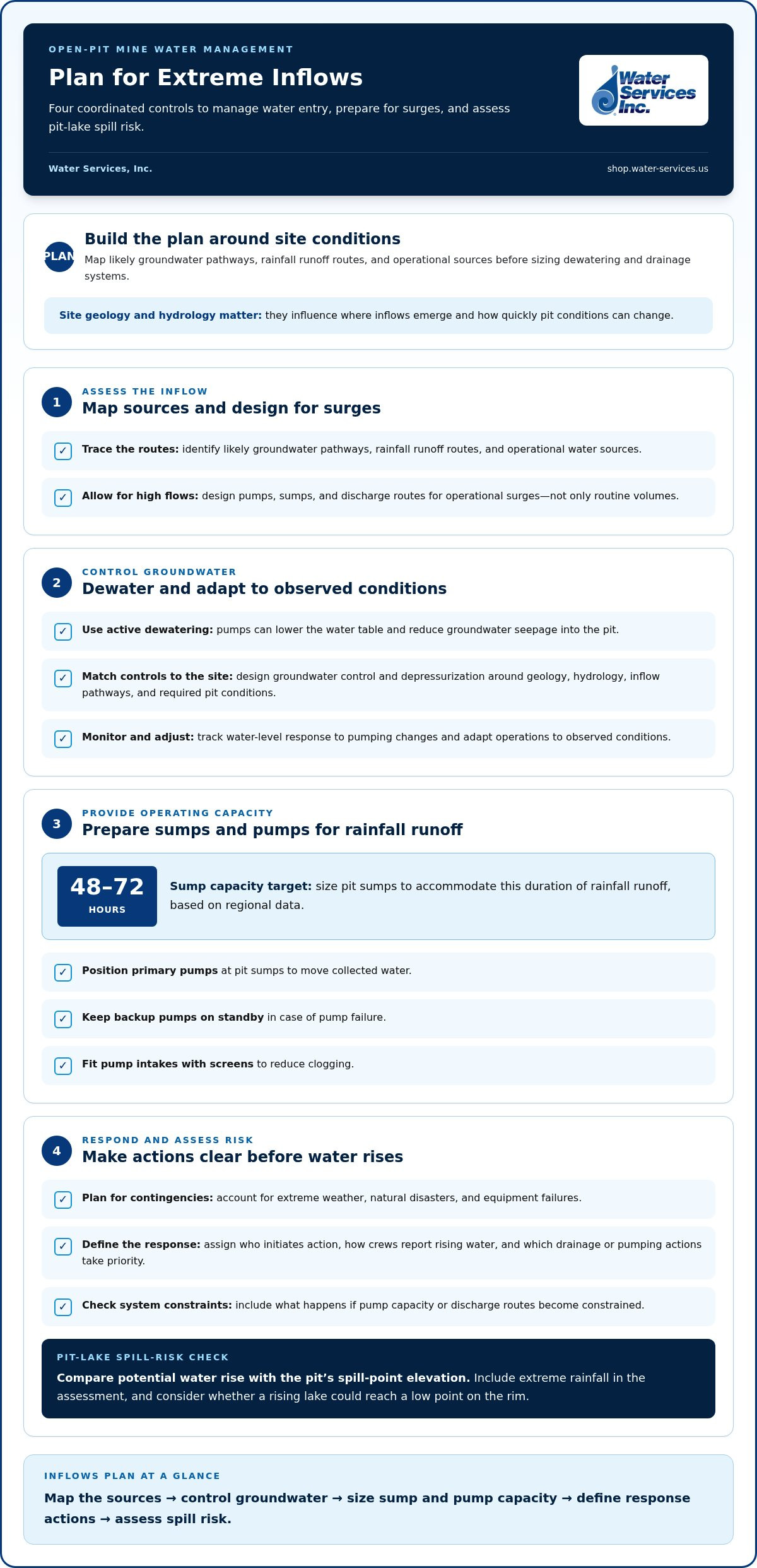
Planning for extreme inflows combines measures to limit water entry with responses for water that reaches the mine. Map likely groundwater pathways, rainfall runoff routes and operational sources before sizing dewatering and drainage systems. Site geology and hydrology influence where inflows emerge and how quickly pit conditions can change. Design for high-flow events, not just routine volumes, so pumps, sumps and discharge routes can handle operational surges.
Open pits manage groundwater inflows through active dewatering, often using pumps to lower the water table and reduce seepage into the pit. Groundwater-control measures and depressurization address water-bearing conditions around the excavation. Design depends on geological and hydrological characteristics, inflow pathways and the required pit conditions. Track how water levels respond to pumping changes, then adjust operations to observed conditions.
Size pit sumps to accommodate 48-72 hours of rainfall runoff based on regional data. Install primary pumps at pit sumps and keep backup pumps on standby for failures. Fit pump intakes with screens to reduce clogging. These controls support the ability to keep water moving during intense inflows, but the system also needs a clear response if pump capacity or discharge routes become constrained.
Build contingency measures around extreme weather, natural disasters and equipment failures. Define who initiates the response, how crews report rising water, and which drainage or pumping actions take priority. Assess pit-lake spill risk by comparing potential water rise with the pit’s spill-point elevation, including extreme rainfall in the assessment. If a rising lake reaches a low point on the rim, surface water can flow out. Revisit inflow assumptions when mine scope or site conditions change, and document revised response steps for operational teams.
4. Surface-water diversion and control
Surface-water controls keep clean runoff from mixing with mine water and entering the pit. Begin by mapping slopes, drainage paths, exposed ground and receiving waters around the excavation. Diversion berms around the pit perimeter can redirect runoff before it reaches sumps or working areas. Separate clean runoff from contact water where practical, then route each flow for suitable containment, treatment or discharge.
In the United States, stormwater design should account for applicable environmental requirements and site-specific discharge limits. Assess the drainage area, rainfall, runoff volume, erosion potential and receiving environment when selecting controls. The required methods depend on site conditions and the water’s intended destination. An Appin Mine plan, for example, specifies a 1-in-10-year storm event lasting 72 hours for its identified runoff-management context. That is a site-specific example, not a universal United States design standard.
Size channels, ponds and diversion structures to manage expected runoff without concentrating flow where it could erode slopes or overwhelm containment. A surface-water dam listed for Appin West has a capacity of 3,500. Because design depends on local rainfall patterns, terrain and catchment area, the plan should connect runoff assumptions to structure capacity and identify what happens when inflow exceeds normal operating conditions.
Inspect controls routinely and after damaging weather. The Appin Mine plan calls for weekly inspections of berms, drainage channels and sediment ponds. Check for erosion, blockages, overtopping, sediment build-up and structural failure, then record corrective work. Sediment ponds can retain suspended solids before water moves to the next management stage. Treatment needs depend on water quality and discharge criteria. Keep inspection records alongside rainfall and water-level observations so recurring problems prompt changes to the layout or maintenance strategy.
The practical takeaway is to keep runoff routes visible, maintain diversion structures and connect each flow path to a defined destination. This makes surface-water control an operating method, not just a drawing in the mine plan.
Water Services: Goulds Water Technology Pumps
Water Services, Inc. offers Goulds Water Technology Pumps for mine-water pumping needs. Consider pump equipment once the site’s water balance and inflow plan establish the volume to move and the required discharge route. Select pumps to match operating conditions and their role in the dewatering system. The plan should also account for standby capacity and maintenance procedures, helping teams respond to changing water levels and equipment issues.
For water-treatment needs, Water Services, Inc. also offers Viqua UV Water Purification Systems, Hydranautics RO Membranes, and Water Treatment Antiscalants and Chemicals. These are distinct treatment options, not substitutes for a site-specific mine-water assessment or a complete water-management plan.
Review the Goulds Water Technology Pumps available for pumping applications, or contact Water Services, Inc. to discuss your needs.
Put the Plan Into Practice
Make the water management plan part of routine operational decisions. Assign responsibility for reviewing monitoring data, recording actions and escalating conditions that require a response. Connect these duties to shift handovers, maintenance schedules and site procedures so the plan guides work rather than sitting apart from it.
Keep the water management plan for open pit mines aligned with changing site conditions. When mine operations, infrastructure or water pathways change, assess whether existing controls and responsibilities still fit. Document revisions and ensure affected personnel understand the updated procedures. This creates a clear link between planning, equipment decisions and daily water management.
Water Services, Inc. offers equipment relevant to mine-water pumping and treatment needs. For product information or to discuss your requirements, contact Water Services, Inc. A practical implementation approach can help your team move from planning decisions to consistent site procedures.
Frequently Asked Questions
What is included in an open-pit mine water management plan?
The plan brings site conditions, operating controls and responsibilities into one working document. Include a site map of water sources, flow paths, storage areas and discharge points, along with objectives, monitoring methods, reporting procedures and assigned accountabilities. Add response steps for flooding, water-quality changes, shortages and equipment failure. A useful plan also records stakeholder consultation and sets review triggers for changes to mine design or operating conditions.
What water quality limits and discharge permits apply to U.S. open-pit mines, including NPDES requirements?
Applicable discharge limits and permit conditions depend on the mine’s authorization and receiving water, so there is no single value for every U.S. site. For an NPDES-related discharge, organize the plan around applicable outfalls, required monitoring parameters, reporting procedures and permit limits. Track pH, conductivity, total suspended solids and heavy metals where relevant, and compare results with the limits governing that discharge.
How should mine water management plans address extreme rainfall, floods, drought, and climate change?
Use scenario planning to test how intense rainfall, flooding and water scarcity could affect site water volumes and operations. Define responses to inflows, constrained pumping, storage limitations and reduced water availability. Consider how changing rainfall patterns could affect runoff assumptions, and revise the water balance when observed conditions shift. Include recovery steps, responsible roles and review triggers after an extreme event or material change in site conditions.
How do water management requirements vary by U.S. state, watershed, and mine type?
Requirements vary with applicable environmental rules, discharge conditions and the mine’s water pathways. A site discharging to a sensitive watershed may need different monitoring parameters or controls from a site retaining water on site. Mine type and geology also shape inflow, seepage and water-quality risks. Build the plan around the specific operation, receiving environment, water sources and discharge destination, then document the requirements for each flow path.
How much do mine dewatering, water treatment, and management systems typically cost?
Mine dewatering costs vary widely with project size, techniques, and site conditions.
0 comments