

Delaying membrane replacement when fouling or scaling causes high differential pressure can increase system energy consumption by up to 25%. For plant managers, this represents a massive, avoidable drain on operational budgets. You already know that waiting for a total system failure leads to expensive, unscheduled downtime and permeate quality that falls below strict compliance standards. The challenge lies in identifying the exact moment when cleaning-in-place (CIP) is no longer sufficient and physical replacement becomes the only economical choice.
Understanding exactly when to replace reverse osmosis membranes requires a shift from calendar-based schedules to precise data normalization. This article provides a technical checklist based on industry standards, including the ASTM D4516-19a methodology. By mastering these metrics, you can protect high-value equipment like Goulds pumps and ensure the longevity of your FilmTec or Hydranautics elements. We will cover the specific triggers for replacement, such as a 10% drop in normalized permeate flow or a 15% increase in differential pressure. This guide ensures your facility maintains consistent water quality for all industrial processes while maximizing the lifespan of your consumables.
Key Takeaways
- Industrial RO membranes maintain a standard operational lifespan of two to five years, acting as the primary barrier against dissolved solids in high-demand environments.
- Identify critical performance triggers, including TDS creep and a 10-15% decline in permeate flux, to determine precisely when to replace reverse osmosis membranes.
- Use technical formulas to monitor salt rejection rates, as a decline below the 95-97% threshold signals a critical failure for industrial water quality standards.
- Implement a data-driven checklist to confirm cleaning-in-place (CIP) ineffectiveness before sourcing high-spec replacements like FilmTec or Hydranautics membranes.
- Optimize system longevity post-replacement by establishing new performance baselines and recalibrating dosing pumps for antiscalants to prevent immediate mineral scaling.
Understanding Industrial RO Membrane Longevity
The primary function of a high-performance polyamide thin-film composite (TFC) membrane is to serve as the molecular barrier in the reverse osmosis separation process. These elements are engineered to reject up to 99.8% of dissolved salts, heavy metals, and organic contaminants. In standard industrial settings with stable feedwater, these units maintain a reliable lifespan of 2 to 5 years. However, this duration isn't a fixed constant. Feedwater chemistry, specifically the concentration of Total Dissolved Solids (TDS), reactive silica, and dissolved organics, dictates the actual replacement timeline. High silica levels are particularly hazardous, as they can form hard, glassy scales that are nearly impossible to remove via chemical cleaning.
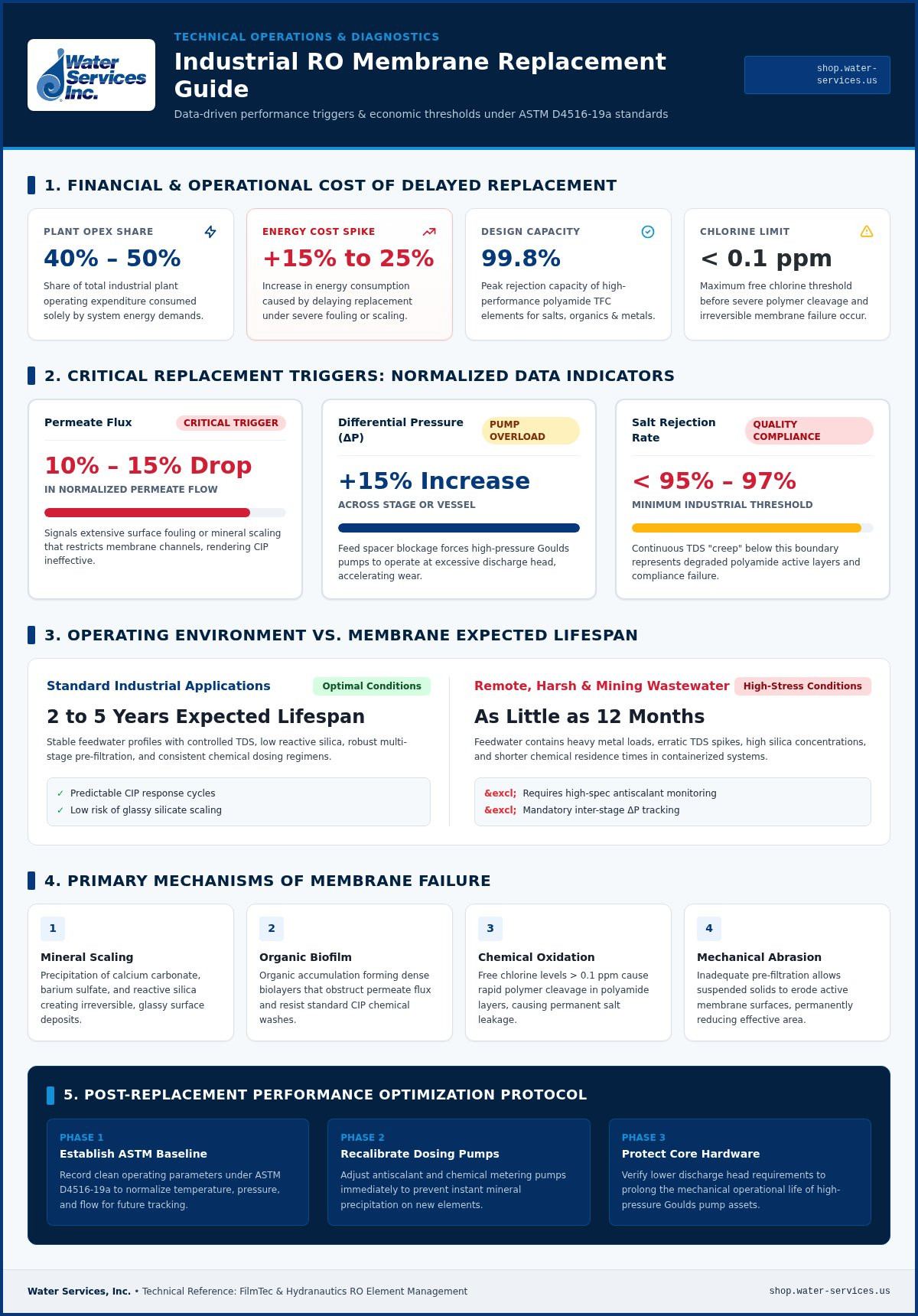
Deciding when to replace reverse osmosis membranes involves a rigorous analysis of the Total Cost of Ownership (TCO). As the membrane surface becomes compromised by hydraulic compaction or irreversible fouling, the system requires higher feed pressures to maintain the design permeate flux. This increased demand places excessive strain on high-value hardware, such as Goulds pumps, and significantly elevates energy consumption. In many industrial plants, energy accounts for 40% to 50% of total operating expenditure. Operating degraded membranes can increase this cost by 15% to 25%, making the investment in new FilmTec or Hydranautics elements the more economical path.
Factors Affecting Membrane Degradation
Chemical fouling remains the most frequent cause of premature membrane failure. Scale precipitation, including calcium carbonate and barium sulfate, physically obstructs the membrane pores. Organic matter buildup creates a dense biofilm that limits permeate passage and resists standard cleaning-in-place (CIP) protocols. Physical degradation is another critical factor. Polyamide membranes are highly sensitive to oxidizing agents. Continuous exposure to free chlorine at levels above 0.1 ppm causes polymer cleavage, leading to a permanent spike in salt passage. Additionally, inadequate pre-filtration allows suspended solids to reach the membrane surface, resulting in mechanical abrasion that reduces the effective surface area and compromises permeate quality.
Lifespan in Remote and Harsh Environments
Industrial sites in remote locations face extreme operational hurdles, especially when implementing mining wastewater treatment solutions. The feedwater in these environments often contains high metal loads and unpredictable TDS spikes, which can reduce membrane lifespan to as little as 12 months. Mobile ultrafiltration and RO units must adapt to these variable conditions with high-spec antiscalants and frequent data logging. Containerized systems require even more vigilant monitoring. Their compact design often results in shorter residence times for pre-treatment chemicals, making the membranes more susceptible to sudden changes in raw water quality. Consistent tracking of differential pressure across each stage is mandatory to prevent catastrophic system downtime.
Key Indicators of Membrane Fouling and Performance Decline
Industrial performance monitoring relies on quantifiable data rather than subjective observations. One of the most critical metrics is TDS "creep," which signifies a gradual increase in salt passage through the membrane. While small fluctuations are normal, a consistent upward trend indicates that the polyamide layer is losing its integrity. According to the FDA technical inspection guide on reverse osmosis, maintaining specific solute rejection ratios is essential for process compliance. If your system's salt rejection falls below the 95% to 97% range, it's a clear signal for immediate technical review.
Another primary indicator is the decline in permeate flux, or flow rate. A normalized permeate flow drop of 10% to 15% suggests that fouling or scaling has significantly restricted the membrane surface. Simultaneously, operators must track the normalized differential pressure ($\Delta P$) across each vessel or stage. A 15% increase in $\Delta P$ indicates that the feed spacer is becoming obstructed. This obstruction forces Goulds Water Technology Pumps to operate at higher discharge pressures to maintain output. If you notice these metrics diverging, it's likely time to evaluate when to replace reverse osmosis membranes to prevent irreversible hardware damage.
Visual and Physical Signs of Failure
Physical inspections provide vital context to digital data. Telescoping, which is the mechanical deformation of the membrane leaves due to excessive pressure drops, indicates severe operational stress. During vessel maintenance, technicians should look for biological slime or hard mineral scaling on the element's exterior. These physical deposits often coincide with distinct odors or discoloration in the permeate stream, suggesting that biofouling or chemical breakthrough has occurred. Ignoring these signs can lead to total system failure and costly emergency repairs.
Impact on System Infrastructure
The health of your membranes directly affects the entire plant's reliability. Operating with fouled elements requires higher net driving pressures, leading to premature wear on seals and impellers within your high-pressure pumps. This relationship is a core focus in modern industrial water filtration systems, where efficiency is prioritized. Energy consumption spikes often serve as a hidden cost of using aged membranes. If your power costs are rising despite stable production volumes, upgrading to new, high-efficiency elements is often the most cost-effective solution. You can find technical specifications for replacement elements and monitoring hardware at the Water Services online store.
Calculating Salt Rejection and Permeate Flux
Precision is the hallmark of industrial water management. Determining when to replace reverse osmosis membranes relies on two primary mathematical pillars: Salt Rejection Rate and Permeate Flux. While raw data provides a snapshot, industrial operators must use normalized values to account for fluctuations in feedwater temperature and pressure. Without this normalization, a drop in performance caused by cold winter water might be mistaken for membrane fouling. Following the ASTM D4516-19a standard ensures that your calculations isolate actual membrane degradation from environmental variables.
The Salt Rejection Formula
The Salt Rejection Rate measures the percentage of dissolved solids the membrane successfully removes from the feedwater. The formula is straightforward: ((Feed TDS - Permeate TDS) / Feed TDS) x 100. For high-performance brackish water elements, a rejection rate below 95% to 97% is generally considered a critical failure. Industrial systems require higher precision than manual TDS pens can provide. Utilizing Walchem Controllers allows for real-time, automated monitoring of these ratios. If a rejection rate remains below the threshold after a thorough cleaning-in-place (CIP), the membrane has likely suffered irreversible chemical oxidation or mechanical wear.
Permeate Flux represents the rate at which water passes through the membrane surface area, typically measured in Gallons per Day (GPD) or Gallons per Square Foot per Day (GFD). A significant decline in flux, specifically a 10% to 15% drop from the initial baseline, indicates that the membrane pores are obstructed. This obstruction forces the system to work harder, increasing the load on your high-pressure pumps. Tracking this metric alongside salt rejection provides a complete picture of membrane health and helps prevent unscheduled system downtime.
Monitoring with Precision Instrumentation
Predictive maintenance is only as good as the hardware providing the data. Integrating Signet Flow Sensors into your RO train provides the accurate flux data necessary for normalization calculations. These sensors detect subtle changes in flow that manual rotameters often miss. Simultaneously, tracking pressure variations with Ashcroft industrial gauges allows you to monitor the differential pressure across each vessel. When these instruments are linked to a central data logger, you can identify performance trends months before they reach a critical state. This proactive approach ensures you're never caught off guard when it's time to source replacement FilmTec or Hydranautics membranes.
The Ultimate RO Membrane Replacement Checklist
Determining when to replace reverse osmosis membranes is a critical decision point for any facility manager. You should only initiate a full replacement after confirming that normalized performance metrics haven't recovered following a standard cleaning-in-place (CIP) cycle. If normalized permeate flow remains 10% below baseline or salt passage stays 5% to 10% higher than the design specification, the elements have reached their end-of-life. Secure high-quality replacements from trusted brands like FilmTec or Hydranautics to ensure long-term reliability. Before starting, technicians must verify the availability of all required Personal Protective Equipment (PPE), including chemical-resistant gloves and face shields, to handle preservative chemicals safely.
Pre-Replacement Preparation
Success begins with a thorough audit of the entire pre-treatment train. Inspect all sediment and carbon pre-filter cartridges for blockages or breakthrough. A high Silt Density Index (SDI) in the feedwater will quickly foul new membranes, so ensure your multimedia filters are functioning correctly. You should also audit your water treatment chemicals to confirm antiscalant dosing pumps are calibrated. Finally, inspect the interior of the pressure vessels for scarring, debris, or biological growth that could damage new elements during loading.
Step-by-Step Installation Protocol
Execution requires a systematic approach to prevent mechanical damage. First, perform a controlled system shutdown and follow all pressure relief protocols. Once the vessel end-caps are removed, extract the old elements and clean the vessel interior with a soft cloth to remove residual scale or slime. Apply a thin layer of food-grade lubricant to all brine seals and interconnector O-rings to ensure a watertight fit. Load the new membranes following the correct flow direction indicated on the element casing. Avoid forcing the elements, as this can roll the O-rings and cause immediate salt passage spikes.
After the elements are seated and end-caps are secured, conduct a low-pressure flush for at least 30 to 60 minutes. This step is mandatory to remove food-grade preservative chemicals, such as sodium metabisulfite, from the membrane leaves. Divert the initial permeate to drain until conductivity stabilizes. Once the system is running at design pressure, log the new baseline data to serve as your future performance benchmark. Browse our full inventory of industrial consumables and replacement elements at the Water Services online store.
Optimizing System Performance Post-Replacement
Post-replacement optimization begins the moment the system reaches steady-state operation, typically within the first 24 to 72 hours. You must establish a new performance baseline for normalized permeate flux and salt rejection. This data serves as the benchmark for all future monitoring and helps you identify precisely when to replace reverse osmosis membranes in the next cycle. Without this initial calibration, it's impossible to distinguish between natural membrane aging and sudden fouling events. Accurate baselining ensures that your operational decisions remain rooted in technical metrics rather than guesswork.
Reviewing the commercial reverse osmosis water filtration system guide provides a framework for long-term efficiency. One critical step is recalibrating dosing pumps for antiscalants. New membranes are highly susceptible to mineral scaling if chemical ratios aren't perfectly matched to the current feedwater profile. Scheduling the next comprehensive audit based on this new data ensures that your maintenance remains proactive. This approach protects high-value components and prevents the rising energy costs associated with operating fouled elements.
Preventative Maintenance Strategies
Automated flush cycles play a vital role in extending membrane life. By purging concentrated salts from the membrane surface during shutdowns, you prevent the precipitation of scale that leads to irreversible damage. Site personnel should be trained on daily performance logging using normalized data rather than raw meter readings. This practice allows for the early detection of feedwater changes that might require adjustments to your water treatment strategy. Matching specific antiscalant chemistries to your silica and hardness levels is essential for maintaining the two to five year lifespan typical of high-performance units.
Sourcing Industrial Components
Choosing genuine FilmTec and Hydranautics membranes is a technical necessity for industrial reliability. Generic alternatives often lack the consistent flux characteristics and salt rejection stability required for high-compliance processes. Genuine elements are engineered to withstand the hydraulic rigors of demanding environments, protecting your upstream investments in Goulds pumps and high-pressure piping. Water Services, Inc. provides the engineering support necessary to ensure these components integrate seamlessly with your existing infrastructure. With global shipping capabilities and a focus on industrial-grade hardware, we ensure your facility maintains peak performance across its entire operational lifecycle.
Securing Long-Term Industrial Water Quality
Maintaining industrial RO performance requires a move away from calendar-based maintenance toward rigorous data normalization. By tracking normalized permeate flux and salt rejection rates according to ASTM D4516-19a, you can identify precisely when to replace reverse osmosis membranes before irreversible hardware damage occurs. A 10% drop in flux or a 15% increase in differential pressure are critical indicators that cleaning-in-place is no longer sufficient. Proactive monitoring protects high-value assets like Goulds pumps and prevents the rising energy costs associated with degraded elements. Don't wait for a total system failure to address performance decline.
Water Services, Inc. has provided global engineering support since 1994, specializing in technical solutions for the mining and industrial sectors. As an authorized distributor for FilmTec and Hydranautics, we maintain a robust inventory of high-performance elements and precision instrumentation. Our expertise ensures your facility meets strict compliance standards while maximizing the lifespan of your consumables. Shop Industrial RO Membranes and Replacement Parts to secure the reliable components your facility requires. Consistent monitoring and quality hardware are the foundations of industrial efficiency.
Frequently Asked Questions
How often should I change industrial RO membranes?
Industrial RO membranes typically last between two and five years under standard operating conditions. This timeline fluctuates based on feedwater chemistry and the effectiveness of your pre-filtration system. In harsh environments like mining sites, high metal loads or silica levels can reduce this duration significantly. Monitoring normalized performance data is the most reliable method for determining when to replace reverse osmosis membranes rather than relying on a fixed calendar schedule.
Can I clean an RO membrane instead of replacing it?
Cleaning-in-place (CIP) is an essential maintenance task that should be performed when normalized flow drops by 10% or differential pressure increases by 15%. However, cleaning cannot reverse physical compaction or chemical oxidation. If your normalized permeate flow doesn't recover to within 80% to 85% of the original baseline after a thorough acid or alkaline wash, the membrane has suffered irreversible fouling. At this stage, physical replacement is the only way to restore system efficiency.
What happens if I don't replace my RO membrane on time?
Failing to replace degraded membranes leads to rising energy costs and potential damage to high-value equipment. As membranes foul, the system requires higher feed pressures to maintain flux, which places excessive strain on Goulds pumps and seals. Additionally, permeate quality will eventually fall below compliance standards, risking process contamination. Delaying replacement often results in unscheduled system downtime and higher total operating expenditures due to increased power consumption and frequent chemical cleanings.
Does water temperature affect RO membrane performance?
Water temperature significantly impacts permeate flow because colder water is more viscous and requires higher pressure to pass through the membrane. A 1-degree Celsius drop in temperature can result in a roughly 3% decrease in permeate flow. This is why data normalization is critical. It allows you to distinguish between a seasonal performance dip and actual membrane fouling. Without temperature correction, you might prematurely decide when to replace reverse osmosis membranes based on environmental variables.
Why is my new RO membrane producing low permeate flow?
Low permeate flow in new elements often stems from inadequate flushing of the food-grade chemical preservatives. You must perform a low-pressure flush for at least 30 to 60 minutes to clear these biocides. Other causes include trapped air in the pressure vessel or rolled O-rings during installation, which can cause internal leaks. If the feed water temperature is lower than the design specification, the flux will also appear lower until you apply the proper temperature correction factors.
How do I calculate the salt rejection rate for my system?
You can calculate the salt rejection rate using the formula: ((Feed TDS - Permeate TDS) / Feed TDS) x 100. This calculation provides the percentage of dissolved solids successfully removed by the membrane. For industrial systems, rejection rates should remain between 95% and 97% for brackish water applications. Using Walchem controllers and Signet flow sensors ensures you have the precise, real-time data needed to perform these calculations accurately and monitor for performance trends.
What are the signs of chemical damage to an RO membrane?
Chemical damage, particularly from chlorine oxidation, typically manifests as a sudden spike in salt passage paired with an increase in permeate flow. Polyamide membranes don't tolerate oxidizing agents, and exposure causes the polymer layer to cleave. This damage is irreversible and cannot be fixed through cleaning. If you notice a surge in permeate conductivity alongside a temporary jump in flux, it's a definitive sign that the membrane's molecular barrier has been compromised.
Is it necessary to replace all membranes in a multi-vessel system at once?
It isn't always necessary to replace every element simultaneously. In multi-stage systems, the lead elements in Stage 1 often suffer from organic fouling, while tail elements in Stage 2 are more prone to mineral scaling. Many industrial operators use staggered replacement strategies to manage budgets and maintain performance. However, you should ensure that any new elements, such as FilmTec or Hydranautics membranes, are compatible with the existing age and flux characteristics of the remaining units.
0 comments