

Recovering most of a factory’s wastewater is not the same as eliminating liquid discharge. For manufacturers, achieving zero liquid discharge in manufacturing means treating wastewater within the facility boundary, recovering water for reuse, and managing the remaining contaminants as solids.
That distinction matters: near-ZLD and minimal liquid discharge systems still release some wastewater. A practical plan for achieving zero liquid discharge in manufacturing must account for the wastewater’s composition, the water quality production processes require, and how the concentrated residual stream will be managed.
This article explains the treatment stages involved in achieving zero liquid discharge in manufacturing, from pretreatment and membranes to thermal processes. It covers how membranes recover water while concentrating contaminants, and how evaporation and crystallization can turn brine into solids. It also considers system complexity and energy demand, both important when assessing whether ZLD fits a facility’s operations.
Key Takeaways
- Distinguish full zero liquid discharge from near-ZLD by whether any wastewater leaves the facility boundary.
- See how pretreatment and membrane stages recover reusable water while concentrating the remaining contaminants.
- Understand why thermal evaporation and crystallization handle concentrated brine, and what energy demands they add.
- Identify how wastewater composition, production needs, and required reuse-water quality shape a practical ZLD system.
What is Zero Liquid Discharge (ZLD) and why does it matter?
Industrial ZLD treats wastewater within a facility, recovers water for reuse, and converts remaining contaminants into solids. Treatment trains can serve power plants, chemical factories, and textile mills where water management must address both reuse and liquid waste control.
Industrial ZLD Treatment Stages
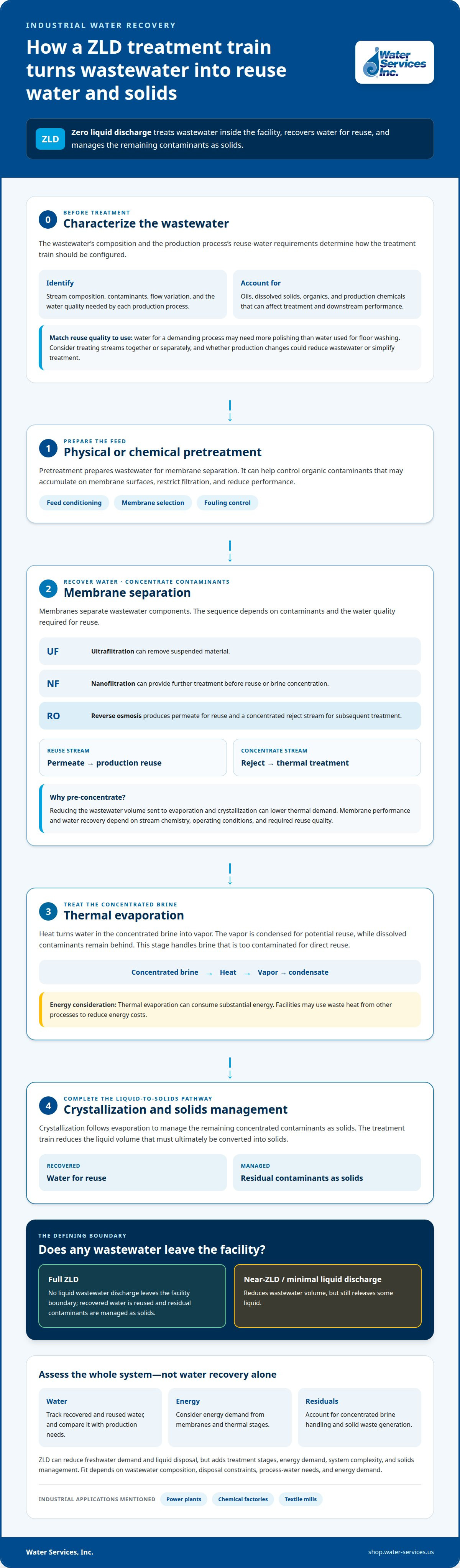
Industrial ZLD is designed to eliminate liquid wastewater discharge at the facility boundary. A typical treatment train uses physical or chemical pretreatment, membrane separation, then evaporation and crystallization to recover water and manage concentrated brine. The sequence matters: each stage prepares wastewater for the next and reduces the liquid volume that must be converted into solids. Municipal treatment plants can also apply water-recovery and solids-management principles.
In the United States, the Clean Water Act dates to 1972, according to the United States Environmental Protection Agency. US ZLD requirements are sector-specific under that law, while California’s SWRCB, Texas’s TCEQ, and New York’s DEC are state regulators whose stricter rules can push water-intensive manufacturers toward ZLD. In Canada, Metal and Diamond Mining Effluent Regulations establish federal effluent quality limits.
ZLD Costs and Treatment Performance
ZLD generally recovers more water and eliminates liquid discharge, but its treatment train is more energy-intensive and complex than discharge management or reuse alone. Minimal liquid discharge reduces wastewater volume but still releases some liquid. Conventional reuse can return treated water to production without converting every residual stream into solids. The right fit depends on wastewater composition, disposal constraints, process-water needs, and energy demand.
When comparing these approaches, measure more than water recovery: track reused water, energy consumption, and solid waste generation. ZLD can reduce freshwater demand and liquid disposal, but concentrating brine and managing solids add treatment stages. Compare those operating requirements with the value of recovered water and the facility’s discharge conditions before selecting a system.
Assessing Wastewater Chemistry
To assess wastewater chemistry, identify stream composition, contaminants, flow variation, and the water quality required by each production process. These findings help determine whether streams should be treated together or separately, and which pretreatment, membranes, and final brine-management stages fit. Oils, dissolved solids, organics, and production chemicals can all affect treatment choices and downstream performance.
Map pollution hotspots and consider whether production changes could reduce wastewater or simplify treatment. Then match the treatment train to the wastewater and intended reuse: water for a demanding process may need more polishing than water used for floor washing. If production changes, the system should accommodate shifts in wastewater composition and adapt to added processes.
Energy efficiency in membrane and thermal systems
Membrane stages reduce the wastewater volume that thermal equipment must process. Energy demand and water recovery depend on stream chemistry, operating conditions, and the quality required for reuse.
Membrane Pre-Concentration Technologies
Reverse osmosis (RO) pre-concentrates wastewater by separating reusable permeate from a concentrated reject stream. This reduces the volume sent to evaporation and crystallization, which can lower thermal demand. Emerging membrane and desalination methods include electrodialysis and membrane distillation. In one described electrodialysis process for brackish-water RO reject, salt rejection is 60-70%, while recovery approaches 97% with multiple stages.
Membranes can also foul when organic contaminants accumulate on their surfaces, restricting filtration and reducing performance. Pretreatment and appropriate membrane selection help control that operational challenge. A membrane-distillation and cooling-crystallization hybrid system achieved vapor flux as high as 8 kg/m2 h and 64 g/kg of feed during 15-cycle experiments.
UF, NF, and RO Filtration
Ultrafiltration (UF), nanofiltration (NF), and reverse osmosis (RO) separate wastewater components using membranes with different functions. UF can remove suspended material, while NF and RO provide further treatment before reuse or brine concentration. The sequence depends on the contaminants and the process-water quality required. RO is a common concentration stage: it produces permeate for reuse and reject for subsequent treatment.
Installation and operating costs per gallon depend on wastewater composition, required recovery, energy use, and the treatment train. Thermal stages and solids management add operating demands, so one cost figure cannot describe every facility.
Common operating challenges include membrane fouling, scaling, and reduced flow. Concentrated brine also requires controlled handling. If the system is not matched to the wastewater chemistry, these issues can increase energy demand and complicate recovery.
Thermal evaporation consumes substantial energy, but facilities may use waste heat from other processes to reduce energy costs. For RO applications, FilmTec reverse osmosis membranes are one available option.
Thermal evaporation and crystallization
After reverse osmosis concentrates wastewater, thermal evaporation treats the remaining brine. Heat turns water into vapor, which is condensed for potential reuse, while dissolved contaminants remain behind. This stage is useful when concentrated brine is too contaminated for direct reuse. It also means ZLD systems must account for energy demand and the solids left after water recovery.
Traditional evaporation and crystallization can consume substantial energy. Facilities may reduce energy costs by using waste heat from other unit processes. The opportunity depends on whether suitable heat is available where and when the evaporator needs it. Mechanical vapor compression units are described across a capacity range of 250-3000 m3/d, illustrating that thermal equipment is used at different treatment scales.
In a crystallizer, further concentration turns brine into solids that can be disposed of or reused. If wastewater contains recyclable materials, treating that stream separately can help recover secondary raw materials instead of mixing them into general waste. Brine chemistry therefore affects both solids handling and potential reuse. Dissolved solids and organics can also make concentration before evaporation difficult, so wastewater characteristics matter in system design.
The SaltMaker pilot at the Paradox Valley Unit treated hypersaline groundwater. It produced freshwater at approximately 500 mg/L total dissolved solids and reached saturated brine at 330,000 mg/L total dissolved solids. The resulting solids consisted of approximately 97% sodium chloride. This example shows how thermal treatment can separate reusable water from concentrated salts, but its results describe that pilot, not every industrial wastewater stream.
Evaporation and crystallization can limit liquid discharge, but the resulting solids still require responsible handling. This process is not a substitute for pollution prevention: reducing wastewater at its source can lower the volume sent through energy-intensive thermal treatment. A facility’s reuse needs, brine chemistry, available waste heat, and solids destination all shape whether this final stage fits its ZLD process.
Definition and purpose of zero liquid discharge
Zero liquid discharge (ZLD) is defined by the facility boundary: wastewater is treated, water is recovered, and residual contaminants leave as solids rather than liquid effluent. The boundary makes the term operational. A factory can recycle water internally yet fall short of full ZLD if wastewater still crosses that boundary as liquid. Near-ZLD and minimal liquid discharge differ because they allow some liquid release.
The purpose extends beyond meeting a discharge constraint. Manufacturers can reduce freshwater consumption by returning recovered water to suitable production uses while limiting the liquid volume sent for disposal. For example, water that does not meet a demanding process specification may still be suitable for floor washing. Matching water quality to the task avoids treating every recovered stream to the same standard.
Water efficiency also depends on production choices made before treatment begins. Manufacturers can reduce wastewater generation by optimizing processes for water consumption and reviewing whether production chemicals complicate recycling. Separating wastewater streams may help too: a concentrated stream containing recoverable materials can be treated apart from general effluent. These choices affect treatment loads and the value of recovered water.
The broader context is substantial. Industrial use represents 8% of water use in low-income countries and 59% in high-income countries. ZLD can support water management where industrial demand competes with other uses, but it is not automatically the most sustainable option for every facility. Treatment intensity, energy use, brine chemistry, and solids disposal all matter. A sound purpose statement therefore sets a facility’s goals together: reduce freshwater intake, reuse water where its quality fits, and manage residual waste responsibly.
The practical takeaway for manufacturers is to define the boundary and intended outcomes before selecting a membrane or thermal process. Track water reuse, energy consumption, and waste generation together: a recovery gain alone does not show whether the overall production system is improving.
Water Services
Water Services, Inc. supplies water-treatment equipment for manufacturers evaluating ZLD processes, including membrane treatment, water transfer, and filtration needs within a broader wastewater plan.
Options include FilmTec Reverse Osmosis Membranes, Hydranautics RO Membranes, Goulds Water Technology Pumps, and Mobile Ultrafiltration Systems. These products support specific treatment and pumping stages. The complete ZLD configuration depends on wastewater chemistry, recovery targets, and how the facility manages concentrated brine and solids.
Share your process requirements and the treatment stage you are planning to discuss suitable equipment options with Water Services, Inc. Contact the team to talk through your manufacturing water-treatment needs.
Plan the next step for your facility
A practical route to achieving zero liquid discharge in manufacturing starts with a clearly defined process boundary and a realistic assessment of each wastewater stream. Identify which production uses can accept recovered water, how concentrated residuals will be managed, and which performance measures matter to your operation. This gives equipment decisions a firm basis and keeps water recovery, energy use, and solids handling in view together.
Water Services offers Goulds Water Technology Pumps, Viqua UV Water Purification Systems, and FilmTec Reverse Osmosis Membranes among its water-treatment equipment. These options address different treatment and pumping needs within a broader system. The appropriate configuration depends on the facility’s wastewater and process requirements.
Discuss your manufacturing water-treatment requirements with Water Services. Contact Water Services to take the next step toward a practical system plan. A clear starting point can make the path forward easier to evaluate.
Frequently Asked Questions
What is zero liquid discharge (ZLD) in manufacturing, and how does it work?
ZLD means a manufacturing facility manages wastewater so liquid effluent does not leave its defined boundary. Trace a wastewater stream from where it is generated through treatment, reuse, and residual handling to understand what that boundary entails. For example, a process stream may produce reusable water and a concentrated reject stream. The facility must manage both outputs to meet its ZLD objective.
What are the main steps and technologies in a manufacturing ZLD system?
A manufacturing ZLD system typically combines pretreatment, membrane separation, and thermal treatment, with each stage addressing a different part of the wastewater stream. Suspended solids, for example, can burden downstream membranes, while concentrated reject may need evaporation and crystallization. The design also needs a plan for returning recovered water to suitable uses and handling residual solids. The exact treatment train depends on wastewater chemistry and the required reuse quality.
Which manufacturing industries and wastewater streams are best suited to ZLD?
ZLD can suit facilities with limited discharge options or wastewater streams that can be treated and reused, including those at chemical plants and textile mills. Streams containing salts or organics need particular attention because they can be difficult to concentrate before evaporation. Manufacturers can also assess whether dyeing wastewater or separate process streams should be treated independently, especially when their chemistry and potential for reuse differ.
How much energy and water can ZLD systems consume or recover?
Water recovery varies with wastewater composition, treatment design, and the quality required for reuse; thermal evaporation and crystallization can make the process energy-intensive. A specialty chemicals manufacturing case study reports approximately 95% of wastewater recovered as water for reuse. That result is specific to the facility, not a general performance guarantee. Energy use likewise depends on how much brine reaches thermal treatment and available waste heat.
What are real-world examples and case studies of ZLD in U.S. manufacturing?
A specialty chemicals manufacturing facility case study reports approximately 95% wastewater recovery, but its location isn’t established, so it shouldn’t be described as a U.S. example. The Paradox Valley Unit pilot provides a separate thermal-treatment example using saline groundwater, not manufacturing wastewater. These cases illustrate different applications; they don’t establish a typical recovery rate or outcome for U.S. manufacturing facilities.
0 comments